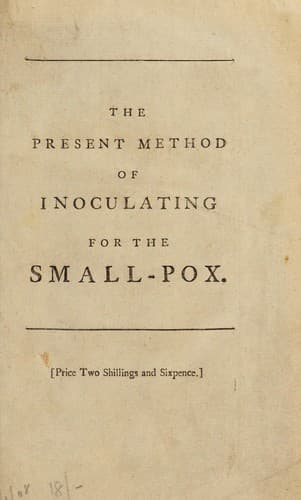
The Present Method of Inoculating for the Small-Pox: To which are added, some experiments, instituted with a view to discover the effects of a similar treatment in the natural small-poxDimsdale, Thomas
History
The Present Method of Inoculating for the Small-Pox: To which are added, some experiments, instituted with a view to discover the effects of a similar treatment in the natural small-pox
Dimsdale, Thomas
Smallpox -- Vaccination -- Early works to 1800
In all cases, when I take matter from an inoculated person, it is from
the place where it was inserted; as I am always sure to find infection
there if the disease succeeds, and always of sufficient energy.
It may appear strange that no bandage, dressing, or application
whatsoever, is made use of to the part infected; but that the most
simple incision being made, and moistened with the smallest particle of
the recent fluid matter, the whole is committed to nature. This method
is however perfectly right, because the application of either plaister
or unguent, as is the usual practice, will occasion an inflammation on
some skins, and in all tend to disguise the natural appearance of the
incision, and prevent our forming a proper judgment of the progress
of the infection; which will afterwards appear to be a matter of much
importance.
If neither an inoculated patient is at hand, nor any one in the
neighbourhood has a distinct kind of the natural disease, a thread may
be used as in the common manner, provided the thread be very recently
infected; but I think it ought to be used as soon as possible after
being charged with infecting matter.
The following method of introducing the disease has likewise been
found effectual; but I have never practised it myself. Dip the point
of a lancet in variolous matter; let it be held in the air till it is
dry; after which it may be closed and kept in the common case without
any further care; and with this prepared lancet raise the scarf skin
obliquely, and keep the lancet a little time in motion between the two
skins, that part of the matter may be mixed with the animal juices;
then withdraw the lancet, and leave the incision uncovered as before.
OF THE PROGRESS OF INFECTION.
Hitherto very little regard seems to have been paid to the progress
of infection discoverable by the part where the operation was
performed. But it will appear in the sequel, that an attention to this
circumstance is very necessary, because a just prognostic may thence be
sometimes formed of the future state of the distemper, and indications
may be taken from the different appearances on the arm, that will
enable us to prevent inconveniencies.
The former method of covering the place of incision with a plaister,
and continuing upon it dressings of one sort or another, prevented much
useful information of this kind. They prevented any judgment by the
touch, and sometimes rendered that by the eye equivocal.
The day after the operation is performed, though it takes effect,
little alteration is discoverable. On the second day, if the part is
viewed with a lens, there generally appears a kind of orange-coloured
stain about the incision, and the surrounding skin seems to contract.
At this time I usually give the following medicine at going to bed,
either mixed with a little of any kind of jelly, or more frequently
made into a pill.
Calomel and compound powder of crabs claws, of each 3 grains,
emetic tartar 1/10 of a grain.
Public-domain text, read in full here on John Shaqi.
Reviews
Reviews
No reviews yet
Be the first to share your thoughts on this work.
Join the Discussion
Join the discussion
Sign in to leave a comment or review.
Sign InorCreate an account