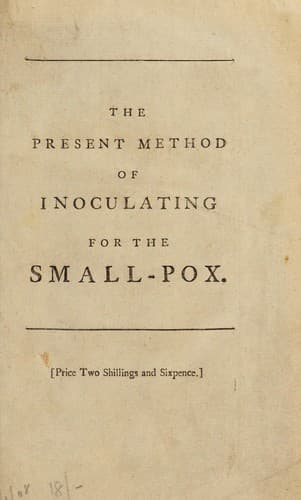
The Present Method of Inoculating for the Small-Pox: To which are added, some experiments, instituted with a view to discover the effects of a similar treatment in the natural small-poxDimsdale, Thomas
History
The Present Method of Inoculating for the Small-Pox: To which are added, some experiments, instituted with a view to discover the effects of a similar treatment in the natural small-pox
Dimsdale, Thomas
Smallpox -- Vaccination -- Early works to 1800
I have also tried the following method, with the same success as that
above described, but do not so well approve of it, because I have been
credibly informed that it has sometimes failed in the practice of
others. A lancet being moistened with the variolous fluid in the same
manner as in the other, is gently introduced, in an oblique manner,
between the scarf and true skin, and the finger of the operator is
applied on the point, in order to wipe off the infection from the
lancet, when it is withdrawn. In this method, as well as in the former,
a little blood will sometimes appear, but I neither draw blood with
design, nor do I think it necessary to wipe it off before the matter is
introduced.
In both these ways of inoculating, neither plaister, bandage, or
covering is applied, or in any respect necessary.
These methods of producing the disease never once have failed me;
and experience has sufficiently proved, that there is no danger from
additional infection by the natural disease at the same time. I
therefore make no scruple of having the person to be inoculated, and
the patient from whom the infection is to be taken, in the same room;
nor have ever perceived any ill consequences attending it. But I advise
the inoculated patients (though perhaps there is no necessity for that
precaution) to be afterwards separated from places of infection till
certain signs of success appear, when all restraint is removed, there
being no danger from accumulation.
It seems to be of no consequence whether the infecting matter be taken
from the natural or inoculated small-pox; I have used both, and never
have been able to discover the least difference, either in point of
certainty of infection, the progress, or the event: and therefore I
take the infection from either, as opportunity offers, or at the option
of my patients or their friends.
Nor is it of consequence whether the matter be taken before, or at the
crisis of, the distemper. It is, I believe, generally supposed, that
the small-pox is not infectious till after the matter has acquired a
certain degree of maturity; and in the common method of inoculation,
this is much attended to; and when the operation has failed, it has
commonly been ascribed to the unripeness of the matter.
But it appears very clearly from the present practice of inoculation,
that so soon as any moisture can be taken from the infected part of
an inoculated patient, previous to the appearance of any pustules,
and even previous to the eruptive fever, this moisture is capable of
communicating the small-pox with the utmost certainty. I have taken a
little clear fluid from the elevated pellicle on the incised part, even
so early as the fourth day after the operation, and have at other times
used matter fully digested at the crisis, with equal success. I chuse,
however, in general, to take matter for infection during the fever of
eruption, as I suppose it at that time to have its utmost activity.
Public-domain text, read in full here on John Shaqi.
Reviews
Reviews
No reviews yet
Be the first to share your thoughts on this work.
Join the Discussion
Join the discussion
Sign in to leave a comment or review.
Sign InorCreate an account