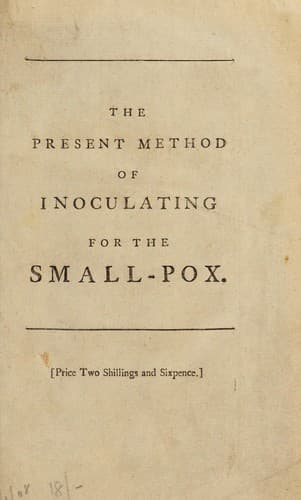
The Present Method of Inoculating for the Small-Pox: To which are added, some experiments, instituted with a view to discover the effects of a similar treatment in the natural small-poxDimsdale, Thomas
History
The Present Method of Inoculating for the Small-Pox: To which are added, some experiments, instituted with a view to discover the effects of a similar treatment in the natural small-pox
Dimsdale, Thomas
Smallpox -- Vaccination -- Early works to 1800
The time of menstruation has generally been the guide in respect to
the inoculation of women; that the whole of the disease might be over
within the menstrual period. This I commonly observe, when I can
choose my time without any inconvenience, and inoculate soon after
the evacuation ceases; though I have no reason to decline performing
the operation at any time, as I can produce many examples in which no
inconvenience has arisen, nor any difference been observable, when this
circumstance has been disregarded.
Women with child have likewise been inoculated, and done well; yet
some particular emergency should be pleaded in excuse for it in
their situation, as it may be attended with some hazard. I have
not inoculated any woman whom I knew to be pregnant; but some who
concealed their pregnancy have been inoculated by me, who, I fancy,
hoped for an event that did not happen, I mean miscarriages: one of
these had a child born nine weeks after inoculation, at the full time,
with distinct marks of the disease, though the mother had very few
eruptions.
Of INFECTION.
The manner of communicating this distemper by inoculation in this
country, has of late been the following: A thread is drawn through
a ripe pustule, and well moistened with the matter: a piece of this
thread is insinuated into a superficial incision made in one or both
arms, near the part where issues are usually fixed; this thread is
covered with a plaister, and there left for a day or two. This is the
most usual way, though others have been practised by several in the
profession.
At present, very different methods are pursued; two of which, that vary
in some respects, I have frequently practised, and shall describe; but
the following has been so invariably successful, as to induce me to
give it the preference.
The patient to be infected being in the same house, and, if no
objection is made to it, in the same room, with one who has the
disease, a little of the variolous matter is taken from the place of
insertion, if the subject is under inoculation; or a pustule, if in the
natural way, on the point of a lancet, so that both sides of the point
are moistened.
With this lancet an incision is made in that part of the arm where
issues are usually placed, deep enough to pass through the scarf skin,
and just to touch the skin itself, and in length as short as possible,
not more than one eighth of an inch.
The little wound being then stretched open between the finger and thumb
of the operator, the incision is moistened with the matter, by gently
touching it with the flat side of the infested lancet. This operation
is generally performed in both arms, and sometimes in two places in one
arm, a little distance from each other. For as I have not observed any
inconvenience from two or three incisions, I seldom trust to one; that
neither I nor my patient may be under any doubt about the success of
the operation from its being performed in one place only.
Public-domain text, read in full here on John Shaqi.
Reviews
Reviews
No reviews yet
Be the first to share your thoughts on this work.
Join the Discussion
Join the discussion
Sign in to leave a comment or review.
Sign InorCreate an account