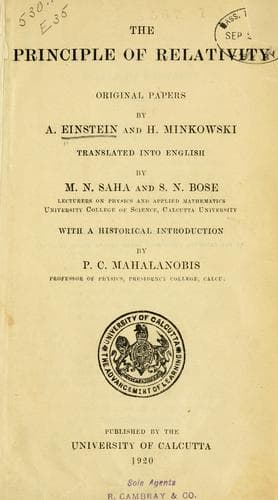
The Principle of Relativity
THE PRINCIPLE OF RELATIVITY
ORIGINAL PAPERS BY
A. EINSTEIN AND H. MINKOWSKI
TRANSLATED INTO ENGLISH BY
M. N. SAHA AND S. N. BOSE
LECTURERS ON PHYSICS AND APPLIED MATHEMATICS
University College of Science, Calcutta University
WITH A HISTORICAL INTRODUCTION BY
P. C. MAHALANOBIS
PROFESSOR OF PHYSICS, PRESIDENCY COLLEGE, CALCU.
PUBLISHED BY THE
UNIVERSITY OF CALCUTTA
1920
_Sole Agents_
R. CAMBRAY & CO.
PRINTED BY ATULCHANDRA BHATTACHARYYA,
AT THE CALCUTTA UNIVERSITY PRESS, SENATE HOUSE, CALCUTTA
TABLE OF CONTENTS
1. Historical Introduction i-xxiii
[By Mr. P. C. Mahalanobis.]
2. On the Electrodynamics of Moving Bodies 1-34
[Einstein’s first paper on the restricted Theory of Relativity,
originally published in the Annalen der Physik in 1905. Translated from
the original German by Dr. Meghnad Saha.]
3. Albrecht Einstein 35-39
[A short biographical note by Dr. Meghnad Saha.]
4. Principle of Relativity 1-52
[H. Minkowski’s original paper on the restricted Principle of Relativity
first published in 1909. Translated from the original German by Dr.
Meghnad Saha.]
5. Appendix to the above by H. Minkowski 53-88
[Translated by Dr. Meghnad Saha.]
6. The Generalised Principle of Relativity 89-163
[A. Einstein’s second paper on the Generalised Principle first published
in 1916. Translated from the original German by Mr. Satyendranath Bose.]
7. Notes 165-185
Transcriber’s Note:
The plain text version of this ebook includes complex mathematical
formulas. Some are simple in-line expressions like k = 1 - 1/μ^2. They
may include special notations such as x^y for x to the power of y, x_{y}
for x with a subscript of y, [=a] for an 'a' with a bar across the top,
[.a] for an 'a' with a dot over it, [..a] for an 'a' with two dots over
it. Others are more complex “ASCII Art” like this:
l l 2lc 2l
t₁ = ------ + ------ = -------- = --- β²
c - u c + u c² - u² c
Some are so complex that they must be rendered in the TeX mathematical
notation, enclosed between double dollar signs, like this:
$$ \beta = (1 - \frac {u^2}{c^2})^{-\frac{1}{2}} $$
HISTORICAL INTRODUCTION
Public-domain text, read in full here on John Shaqi.
Reviews
Reviews
No reviews yet
Be the first to share your thoughts on this work.
Join the Discussion
Join the discussion
Sign in to leave a comment or review.
Sign InorCreate an account