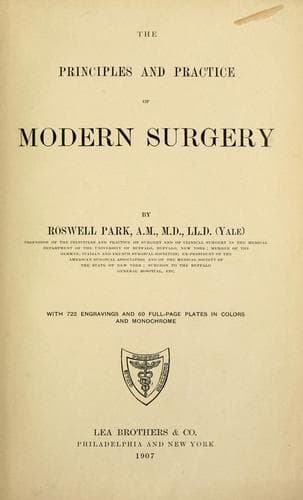
The principles and practice of modern surgery — John Shaqi
The principles and practice of modern surgeryPark, Roswell
Science
The principles and practice of modern surgery
Park, Roswell
Surgery
The best examples of the _hyperemia of paralysis_ are perhaps to be
met with after certain injuries to nerves, as, for instance, flushing
of the face and hypersecretion of nasal mucus, tears, etc., after
injury to the cervical sympathetic. Such, too, in its essentials is
that form of shock known as brain concussion, which is often followed
by nutritive disturbances among the brain cells, with consequent
perversion of brain function.
Waller’s experiment of placing a freezing mixture over the ulnar
nerve at the back of the elbow is also significant, the result being
congestion and elevation of surface temperature of the fingers supplied
by this nerve. Congestion and swelling have also been observed after
fracture of the internal condyle of the humerus, by which this nerve
was pressed upon; and similar phenomena may be noted in fingers or toes
as the result of injuries of other nerves.
Hyperemia due to _paralysis of the perivascular ganglia_ is observed
sometimes in transplanted flaps, in the suffusion of a limb after
removal of the Esmarch bandage, in the congestion of certain sac walls
after tapping, in the hyperemia of, perhaps even hemorrhage from, the
bladder wall after too quickly relieving its overdistention, and in
the swelling of the extremities when they begin to be first used after
having been put at rest because of injury.
The _hyperemias of dilatation_ are more acute in course and
manifestation. Along with them go sharp pain, hypersecretion of
glands, edema, and sometimes desquamation of superficial parts. The
facial blush due to effusion; the temporary flushing due to indulgence
in alcohol; the suffusion of the conjunctiva, perhaps the face,
with hyperlacrymation, accompanying facial neuralgia or hemicrania;
and the hyperemia consequent upon herpes zoster, urticaria, etc.,
are illustrative examples of this form. The erythema due to nerve
irritation or injury, the swelling of the joints which appears
after similar lesions, and that condition described by Mitchell as
_erythromelalgia_, probably also belong here. In fact, almost all the
reflex hyperemias are hyperemias of dilatation.
The forms of hyperemia considered above belong mainly to the
designation of _active_.
Public-domain text, read in full here on John Shaqi.
Reviews
Reviews
No reviews yet
Be the first to share your thoughts on this work.
Join the Discussion
Join the discussion
Sign in to leave a comment or review.
Sign InorCreate an account