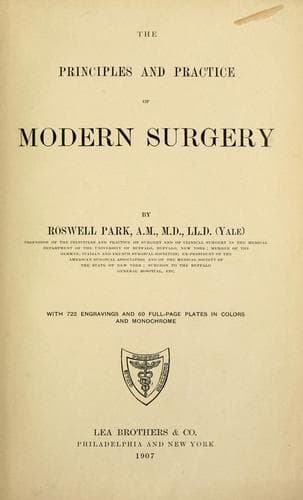
The principles and practice of modern surgeryPark, Roswell
Science
The principles and practice of modern surgery
Park, Roswell
Surgery
=Active Hyperemia.=--Active hyperemia may be produced by purely
nervous influences, even those of emotional origin. The flushing of
the face which is known as “blushing” is, perhaps, the most common
illustration of this fact. It is well known also that this is, in
some degree at least, the result of division of certain nerves which
have to do with the regulation of the blood supply. The cervical
sympathetic is the best known and most often studied of these, and the
consequences of division of this nerve in the neck are stated in all
the text-books on physiology. So also by electrical stimulation of
certain nerves the parts supplied by them can be made to show a very
active hyperemia, which will subside shortly after discontinuance of
stimulation, providing this has not been kept up too long. In active
hyperemia there is absolute increase of intra-arterial tension, and
under these circumstances pulsation may be noted in those small vessels
in which commonly it is not seen nor felt. This is the explanation
of the throbbing pain complained of under many actively hyperemic
conditions. This hyperemia affords the explanation of the clinical
signs to which attention has already been called. The increased heat
of the part is the result of greater access of blood, which prevents
cooling by radiation and evaporation; the peculiar redness is due to
the greater filling of the capillaries with the blood, which gives the
peculiar hue to the skin and visible textures; while to the increased
pressure upon sensory nerves is also due the pain. The minuter changes
occurring within the congested part call for more accurate description.
Whether or not there is actual dilatation of capillaries under these
circumstances is a matter still under dispute, but of the dilatation of
the larger vessels there can be no possible question.
As hyperemia is to such a great extent brought about by action
of the nervous system, it is well to divide it more accurately
into the hyperemia of paralysis, or _neuroparalytic congestion_,
which is the result of a paralysis of the constrictor fibers of
the vasomotor system, and into the hyperemia of irritation, or
_neurotonic congestion_, which is due to the irritation of the dilators
(Recklinghausen). Physiologists are fairly well agreed that as between
the dilating and the constricting apparatus of the vasomotor system
there is ordinarily preserved a certain degree of equilibrium; to which
fact is probably due that normal condition of affairs inaugurated after
temporary disturbance, since overaction in one direction succeeds
reaction in the other. As Warren has illustrated this, our common
treatment of frostbite by cold applications is a concession to this
fact, since by the cold applications we endeavor to limit the reaction
which would otherwise follow after thawing out the frozen part.
Public-domain text, read in full here on John Shaqi.
Reviews
Reviews
No reviews yet
Be the first to share your thoughts on this work.
Join the Discussion
Join the discussion
Sign in to leave a comment or review.
Sign InorCreate an account