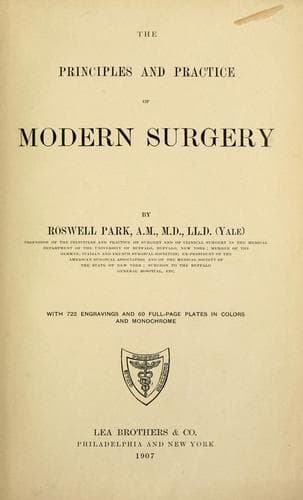
The principles and practice of modern surgeryPark, Roswell
Science
The principles and practice of modern surgery
Park, Roswell
Surgery
With traumatisms surgery alone is mainly concerned, but its conceded
scope is now widened to include an ever-increasing number of morbid
conditions, which, in time past, were treated medicinally--or not at
all. Thus it has come to pass that it is no longer possible to make an
abrupt distinction between medicine and surgery, nor even briefly to
define the words “surgery” and “surgeon,” nor yet to ascribe to either
the physician or the surgeon his exact functions as such. In centuries
past physicians were exceedingly jealous of their vested rights, and
with propriety, when the only surgeons were uneducated barbers. But
about one hundred years ago conditions were materially altered for the
better, and surgery, liberated from its medieval environment, and from
the restrictions imposed by the clergy, rapidly developed into both a
science and an art, while the surgeon came to take that position in
society to which his increasing attainments entitled him. During the
past thirty years surgery, thanks to earnest workers in the surgical
laboratories of the world, has made progress scarcely equalled by the
science of electricity, and the impossibilities of yesterday have
become the routine of today.
Thus has come about the earlier separation, and now, in some respects
at least, the closer appreciation of the respective scope and functions
of the physician and the surgeon. Between them lies yet what has been
felicitously called the “borderland,” where they meet on common ground,
too often as rivals and not often enough as co-workers. Nowhere do
comprehensive knowledge, wide experience, and trained judgment appear
to better advantage, nor lead to better results, than when exhibited
where co-operation in these respects is most hearty. Someone has most
happily said that “the surgeon is a physician who knows how to use his
hands,” yet to regard a course in surgery as one in manual training
would be a most lamentable conception of its purposes. Rather is
it to be regarded as a superstructure, to be built upon a thorough
familiarity with anatomy, physiology, pathology, and therapeutics. In
fact, the better general practitioner a man is, the better surgeon may
he thereby become, providing he possess the other necessary attributes.
John Hunter took this view, but too many since his day have forgotten
or never realized it.
Public-domain text, read in full here on John Shaqi.
Reviews
Reviews
No reviews yet
Be the first to share your thoughts on this work.
Join the Discussion
Join the discussion
Sign in to leave a comment or review.
Sign InorCreate an account