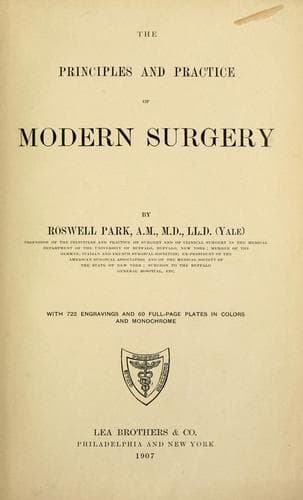
The principles and practice of modern surgery — John Shaqi
The principles and practice of modern surgeryPark, Roswell
Science
The principles and practice of modern surgery
Park, Roswell
Surgery
To their more exact study we must, however, make some preface in the
way of general remarks concerning a phenomenon everywhere easily
recognized, but as yet incompletely understood. This phenomenon has
reference to an undue supply of blood to a part, and is commonly known
under two terms which are practically synonymous, namely, _congestion_
and _hyperemia_. To begin with these, then, we must note, first of all,
that congestion and hyperemia may be--
A. _Active_; and
B. _Passive_.
They may also be spoken of as--
1. _Acute_; and
2. _Chronic_.
Considering first the two latter distinctions, it will be found that
the acute hyperemias are met with most often in consequence of sharp
mechanical disturbances. The chronic hyperemias, on the contrary, are
conditions which in many individuals are more or less permanent. Note
accurately here the proper significance of certain terms. Hyperemia
means, in effect, an oversupply of blood to the given part; the term
should have only a local significance. When the entire body seems to be
too well supplied with blood, the condition is known as _plethora_, the
counterpart of which term is usually _anemia_. The direct counterpart
of the term _hyperemia_ should perhaps be _ischemia_, meaning a
perverted blood supply in reduced amount. With plethora and anemia
as terms implying general conditions, with hyperemia and ischemia
implying local conditions, there should be little room for confusion in
phraseology.
The active form of hyperemia used to be called “fluxion,” a term now
rarely used. _Active hyperemia_ means an increased supply of _arterial_
blood. In _passive hyperemia_ the oversupply is rather of _venous_
blood. In the former case the condition seems due to overactivity of
the heart, with such local tissue changes as permit it to occur. In
passive hyperemia the blood current is slower--there is a tendency
toward, and sometimes an actual, stagnation; all of which is usually
due to obstruction of the return of blood to the heart. The conditions
permitting these two results may be widely variant.
Public-domain text, read in full here on John Shaqi.
Reviews
Reviews
No reviews yet
Be the first to share your thoughts on this work.
Join the Discussion
Join the discussion
Sign in to leave a comment or review.
Sign InorCreate an account