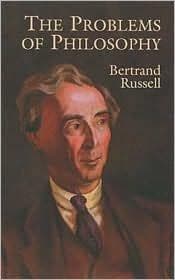
Knowledge, Theory of; Metaphysics; Philosophy -- Introductions
My knowledge of the table as a physical object, on the contrary, is not
direct knowledge. Such as it is, it is obtained through acquaintance
with the sense-data that make up the appearance of the table. We have
seen that it is possible, without absurdity, to doubt whether there is
a table at all, whereas it is not possible to doubt the sense-data. My
knowledge of the table is of the kind which we shall call 'knowledge
by description'. The table is 'the physical object which causes
such-and-such sense-data'. This describes the table by means of the
sense-data. In order to know anything at all about the table, we must
know truths connecting it with things with which we have acquaintance:
we must know that 'such-and-such sense-data are caused by a physical
object'. There is no state of mind in which we are directly aware of the
table; all our knowledge of the table is really knowledge of truths, and
the actual thing which is the table is not, strictly speaking, known
to us at all. We know a description, and we know that there is just one
object to which this description applies, though the object itself is
not directly known to us. In such a case, we say that our knowledge of
the object is knowledge by description.
All our knowledge, both knowledge of things and knowledge of truths,
rests upon acquaintance as its foundation. It is therefore important to
consider what kinds of things there are with which we have acquaintance.
Sense-data, as we have already seen, are among the things with which
we are acquainted; in fact, they supply the most obvious and striking
example of knowledge by acquaintance. But if they were the sole example,
our knowledge would be very much more restricted than it is. We should
only know what is now present to our senses: we could not know anything
about the past--not even that there was a past--nor could we know any
truths about our sense-data, for all knowledge of truths, as we shall
show, demands acquaintance with things which are of an essentially
different character from sense-data, the things which are sometimes
called 'abstract ideas', but which we shall call 'universals'. We have
therefore to consider acquaintance with other things besides sense-data
if we are to obtain any tolerably adequate analysis of our knowledge.
The first extension beyond sense-data to be considered is acquaintance
by _memory_. It is obvious that we often remember what we have seen or
heard or had otherwise present to our senses, and that in such cases we
are still immediately aware of what we remember, in spite of the fact
that it appears as past and not as present. This immediate knowledge by
memory is the source of all our knowledge concerning the past: without
it, there could be no knowledge of the past by inference, since we
should never know that there was anything past to be inferred.
Public-domain text, read in full here on John Shaqi.
Reviews
Reviews
No reviews yet
Be the first to share your thoughts on this work.
Join the Discussion
Join the discussion
Sign in to leave a comment or review.
Sign InorCreate an account