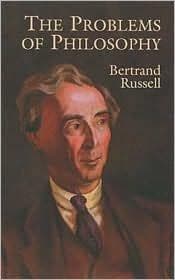
Knowledge, Theory of; Metaphysics; Philosophy -- Introductions
At the end of the preceding chapter we saw that such entities as
relations appear to have a being which is in some way different from
that of physical objects, and also different from that of minds and from
that of sense-data. In the present chapter we have to consider what is
the nature of this kind of being, and also what objects there are that
have this kind of being. We will begin with the latter question.
The problem with which we are now concerned is a very old one, since it
was brought into philosophy by Plato. Plato's 'theory of ideas' is an
attempt to solve this very problem, and in my opinion it is one of the
most successful attempts hitherto made. The theory to be advocated in
what follows is largely Plato's, with merely such modifications as time
has shown to be necessary.
The way the problem arose for Plato was more or less as follows. Let
us consider, say, such a notion as _justice_. If we ask ourselves what
justice is, it is natural to proceed by considering this, that, and the
other just act, with a view to discovering what they have in common.
They must all, in some sense, partake of a common nature, which will be
found in whatever is just and in nothing else. This common nature, in
virtue of which they are all just, will be justice itself, the pure
essence the admixture of which with facts of ordinary life produces the
multiplicity of just acts. Similarly with any other word which may be
applicable to common facts, such as 'whiteness' for example. The word
will be applicable to a number of particular things because they all
participate in a common nature or essence. This pure essence is what
Plato calls an 'idea' or 'form'. (It must not be supposed that 'ideas',
in his sense, exist in minds, though they may be apprehended by minds.)
The 'idea' _justice_ is not identical with anything that is just: it is
something other than particular things, which particular things partake
of. Not being particular, it cannot itself exist in the world of sense.
Moreover it is not fleeting or changeable like the things of sense: it
is eternally itself, immutable and indestructible.
Thus Plato is led to a supra-sensible world, more real than the common
world of sense, the unchangeable world of ideas, which alone gives to
the world of sense whatever pale reflection of reality may belong to it.
The truly real world, for Plato, is the world of ideas; for whatever
we may attempt to say about things in the world of sense, we can only
succeed in saying that they participate in such and such ideas, which,
therefore, constitute all their character. Hence it is easy to pass
on into a mysticism. We may hope, in a mystic illumination, to see the
ideas as we see objects of sense; and we may imagine that the ideas
exist in heaven. These mystical developments are very natural, but the
basis of the theory is in logic, and it is as based in logic that we
have to consider it.
Public-domain text, read in full here on John Shaqi.
Reviews
Reviews
No reviews yet
Be the first to share your thoughts on this work.
Join the Discussion
Join the discussion
Sign in to leave a comment or review.
Sign InorCreate an account