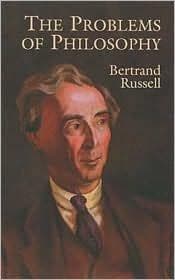
Knowledge, Theory of; Metaphysics; Philosophy -- Introductions
The word 'idea' has acquired, in the course of time, many associations
which are quite misleading when applied to Plato's 'ideas'. We shall
therefore use the word 'universal' instead of the word 'idea', to
describe what Plato meant. The essence of the sort of entity that Plato
meant is that it is opposed to the particular things that are given in
sensation. We speak of whatever is given in sensation, or is of the same
nature as things given in sensation, as a _particular_; by opposition
to this, a _universal_ will be anything which may be shared by many
particulars, and has those characteristics which, as we saw, distinguish
justice and whiteness from just acts and white things.
When we examine common words, we find that, broadly speaking, proper
names stand for particulars, while other substantives, adjectives,
prepositions, and verbs stand for universals. Pronouns stand for
particulars, but are ambiguous: it is only by the context or the
circumstances that we know what particulars they stand for. The word
'now' stands for a particular, namely the present moment; but like
pronouns, it stands for an ambiguous particular, because the present is
always changing.
It will be seen that no sentence can be made up without at least one
word which denotes a universal. The nearest approach would be some such
statement as 'I like this'. But even here the word 'like' denotes
a universal, for I may like other things, and other people may like
things. Thus all truths involve universals, and all knowledge of truths
involves acquaintance with universals.
Seeing that nearly all the words to be found in the dictionary stand
for universals, it is strange that hardly anybody except students of
philosophy ever realizes that there are such entities as universals. We
do not naturally dwell upon those words in a sentence which do not stand
for particulars; and if we are forced to dwell upon a word which stands
for a universal, we naturally think of it as standing for some one of
the particulars that come under the universal. When, for example, we
hear the sentence, 'Charles I's head was cut off', we may naturally
enough think of Charles I, of Charles I's head, and of the operation
of cutting off _his_ head, which are all particulars; but we do not
naturally dwell upon what is meant by the word 'head' or the word
'cut', which is a universal: We feel such words to be incomplete and
insubstantial; they seem to demand a context before anything can be
done with them. Hence we succeed in avoiding all notice of universals as
such, until the study of philosophy forces them upon our attention.
Public-domain text, read in full here on John Shaqi.
Reviews
Reviews
No reviews yet
Be the first to share your thoughts on this work.
Join the Discussion
Join the discussion
Sign in to leave a comment or review.
Sign InorCreate an account