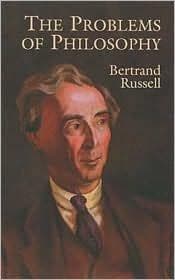
Knowledge, Theory of; Metaphysics; Philosophy -- Introductions
We spoke of the relation called 'judging' or 'believing' as knitting
together into one complex whole the subject and the objects. In this
respect, judging is exactly like every other relation. Whenever a
relation holds between two or more terms, it unites the terms into a
complex whole. If Othello loves Desdemona, there is such a complex whole
as 'Othello's love for Desdemona'. The terms united by the relation may
be themselves complex, or may be simple, but the whole which results
from their being united must be complex. Wherever there is a relation
which relates certain terms, there is a complex object formed of the
union of those terms; and conversely, wherever there is a complex
object, there is a relation which relates its constituents. When an act
of believing occurs, there is a complex, in which 'believing' is the
uniting relation, and subject and objects are arranged in a certain
order by the 'sense' of the relation of believing. Among the objects,
as we saw in considering 'Othello believes that Desdemona loves Cassio',
one must be a relation--in this instance, the relation 'loving'. But
this relation, as it occurs in the act of believing, is not the relation
which creates the unity of the complex whole consisting of the subject
and the objects. The relation 'loving', as it occurs in the act of
believing, is one of the objects--it is a brick in the structure, not
the cement. The cement is the relation 'believing'. When the belief is
_true_, there is another complex unity, in which the relation which was
one of the objects of the belief relates the other objects. Thus, e.g.,
if Othello believes _truly_ that Desdemona loves Cassio, then there is
a complex unity, 'Desdemona's love for Cassio', which is composed
exclusively of the _objects_ of the belief, in the same order as they
had in the belief, with the relation which was one of the objects
occurring now as the cement that binds together the other objects of the
belief. On the other hand, when a belief is _false_, there is no such
complex unity composed only of the objects of the belief. If Othello
believes _falsely_ that Desdemona loves Cassio, then there is no such
complex unity as 'Desdemona's love for Cassio'.
Thus a belief is _true_ when it _corresponds_ to a certain associated
complex, and _false_ when it does not. Assuming, for the sake of
definiteness, that the objects of the belief are two terms and a
relation, the terms being put in a certain order by the 'sense' of
the believing, then if the two terms in that order are united by the
relation into a complex, the belief is true; if not, it is false. This
constitutes the definition of truth and falsehood that we were in search
of. Judging or believing is a certain complex unity of which a mind is
a constituent; if the remaining constituents, taken in the order which
they have in the belief, form a complex unity, then the belief is true;
if not, it is false.
Public-domain text, read in full here on John Shaqi.
Reviews
Reviews
No reviews yet
Be the first to share your thoughts on this work.
Elsewhere in the archive
Join the Discussion
Join the discussion
Sign in to leave a comment or review.
Sign InorCreate an account