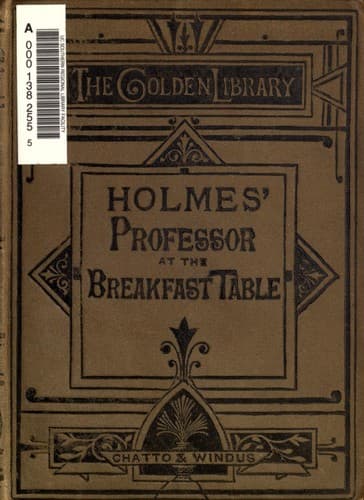
The Professor at the Breakfast-TableHolmes, Oliver Wendell
General
The Professor at the Breakfast-Table
Holmes, Oliver Wendell
American fiction -- 19th century; Conversation -- Fiction; Poetry
One who means to talk with entire sincerity,--I said,--always feels
himself in danger of two things, namely,--an affectation of bluntness,
like that of which Cornwall accuses Kent in “Lear,” and actual rudeness.
What a man wants to do, in talking with a stranger, is to get and to
give as much of the best and most real life that belongs to the two
talkers as the time will let him. Life is short, and conversation apt
to run to mere words. Mr. Hue I think it is, who tells us some very good
stories about the way in which two Chinese gentlemen contrive to keep up
a long talk without saying a word which has any meaning in it. Something
like this is occasionally heard on this side of the Great Wall. The best
Chinese talkers I know are some pretty women whom I meet from time
to time. Pleasant, airy, complimentary, the little flakes of flattery
glimmering in their talk like the bits of gold-leaf in eau-de-vie de
Dantzic; their accents flowing on in a soft ripple,--never a wave,
and never a calm; words nicely fitted, but never a colored phrase or
a highly-flavored epithet; they turn air into syllables so gracefully,
that we find meaning for the music they make as we find faces in the
coals and fairy palaces in the clouds. There is something very odd,
though, about this mechanical talk.
You have sometimes been in a train on the railroad when the engine was
detached a long way from the station you were approaching? Well, you
have noticed how quietly and rapidly the cars kept on, just as if the
locomotive were drawing them? Indeed, you would not have suspected that
you were travelling on the strength of a dead fact, if you had not seen
the engine running away from you on a side-track. Upon my conscience,
I believe some of these pretty women detach their minds entirely,
sometimes, from their talk,--and, what is more, that we never know the
difference. Their lips let off the fluty syllables just as their fingers
would sprinkle the music-drops from their pianos; unconscious habit
turns the phrase of thought into words just as it does that of
music into notes.--Well, they govern the world for all that, these
sweet-lipped women,--because beauty is the index of a larger fact than
wisdom.
--The Bombazine wanted an explanation.
Madam,--said I,--wisdom is the abstract of the past, but beauty is the
promise of the future.
--All this, however, is not what I was going to say. Here am I, suppose,
seated--we will say at a dinner-table--alongside of an intelligent
Englishman. We look in each other's faces,--we exchange a dozen words.
One thing is settled: we mean not to offend each other,--to be perfectly
courteous,--more than courteous; for we are the entertainer and the
entertained, and cherish particularly amiable feelings, to each other.
The claret is good; and if our blood reddens a little with its warm
crimson, we are none the less kind for it.
Public-domain text, read in full here on John Shaqi.
Reviews
Reviews
No reviews yet
Be the first to share your thoughts on this work.
Join the Discussion
Join the discussion
Sign in to leave a comment or review.
Sign InorCreate an account