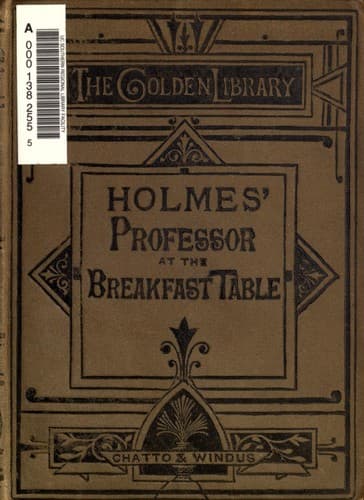
The Professor at the Breakfast-TableHolmes, Oliver Wendell
General
The Professor at the Breakfast-Table
Holmes, Oliver Wendell
American fiction -- 19th century; Conversation -- Fiction; Poetry
I don't think people that talk over their victuals are like to say
anything very great, especially if they get their heads muddled with
strong drink before they begin jabberin'.
The Bombazine uttered this with a sugary sourness, as if the words had
been steeped in a solution of acetate of lead.--The boys of my time used
to call a hit like this a “side-winder.”
--I must finish this woman.--
Madam,--I said,--the Great Teacher seems to have been fond of talking as
he sat at meat. Because this was a good while ago, in a far-off place,
you forget what the true fact of it was,--that those were real
dinners, where people were hungry and thirsty, and where you met a very
miscellaneous company. Probably there was a great deal of loose talk
among the guests; at any rate, there was always wine, we may believe.
Whatever may be the hygienic advantages or disadvantages of wine,--and
I for one, except for certain particular ends, believe in water, and,
I blush to say it, in black tea,--there is no doubt about its being the
grand specific against dull dinners. A score of people come together in
all moods of mind and body. The problem is, in the space of one hour,
more or less, to bring them all into the same condition of slightly
exalted life. Food alone is enough for one person, perhaps,--talk,
alone, for another; but the grand equalizer and fraternizer, which works
up the radiators to their maximum radiation, and the absorbents to their
maximum receptivity, is now just where it was when
The conscious water saw its Lord and blushed,
--when six great vessels containing water, the whole amounting to more
than a hogshead-full, were changed into the best of wine. I once wrote
a song about wine, in which I spoke so warmly of it, that I was afraid
some would think it was written inter pocula; whereas it was composed
in the bosom of my family, under the most tranquillizing domestic
influences.
--The divinity-student turned towards me, looking mischievous.--Can you
tell me,--he said,--who wrote a song for a temperance celebration once,
of which the following is a verse?
Alas for the loved one, too gentle and fair
The joys of the banquet to chasten and share!
Her eye lost its light that his goblet might shine,
And the rose of her cheek was dissolved in his wine!
I did,--I answered.--What are you going to do about it?--I will tell you
another line I wrote long ago:--
Don't be “consistent,”--but be simply true.
Public-domain text, read in full here on John Shaqi.
Reviews
Reviews
No reviews yet
Be the first to share your thoughts on this work.
Join the Discussion
Join the discussion
Sign in to leave a comment or review.
Sign InorCreate an account