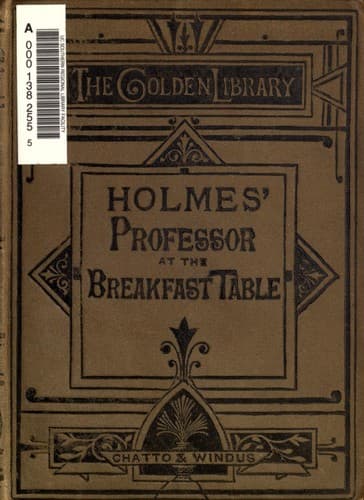
The Professor at the Breakfast-TableHolmes, Oliver Wendell
General
The Professor at the Breakfast-Table
Holmes, Oliver Wendell
American fiction -- 19th century; Conversation -- Fiction; Poetry
I observe that a deep layer of thought sometimes makes itself felt
through the superincumbent strata, thus:--The usual single or double
currents shall flow on, but there shall be an influence blending with
them, disturbing them in an obscure way, until all at once I say,--Oh,
there! I knew there was something troubling me,--and the thought which
had been working through comes up to the surface clear, definite, and
articulates itself,--a disagreeable duty, perhaps, or an unpleasant
recollection.
The inner world of thought and the outer world of events are alike in
this, that they are both brimful. There is no space between consecutive
thoughts, or between the never-ending series of actions. All pack tight,
and mould their surfaces against each other, so that in the long run
there is a wonderful average uniformity in the forms of both thoughts
and actions, just as you find that cylinders crowded all become
hexagonal prisms, and spheres pressed together are formed into regular
polyhedra.
Every event that a man would master must be mounted on the run, and no
man ever caught the reins of a thought except as it galloped by him.
So, to carry out, with another comparison, my remark about the layers of
thought, we may consider the mind as it moves among thoughts or events,
like a circus-rider whirling round with a great troop of horses. He can
mount a fact or an idea, and guide it more or less completely, but he
cannot stop it. So, as I said in another way at the beginning, he can
stride two or three thoughts at once, but not break their steady walk,
trot, or gallop. He can only take his foot from the saddle of one
thought and put it on that of another.
--What is the saddle of a thought? Why, a word, of course.--Twenty years
after you have dismissed a thought, it suddenly wedges up to you through
the press, as if it had been steadily galloping round and round all that
time without a rider.
The will does not act in the interspaces of thought, for there are no
such interspaces, but simply steps from the back of one moving thought
upon that of another.
--I should like to ask,--said the divinity-student,--since we are
getting into metaphysics, how you can admit space, if all things are in
contact, and how you can admit time, if it is always now to something?
--I thought it best not to hear this question.
Public-domain text, read in full here on John Shaqi.
Reviews
Reviews
No reviews yet
Be the first to share your thoughts on this work.
Join the Discussion
Join the discussion
Sign in to leave a comment or review.
Sign InorCreate an account