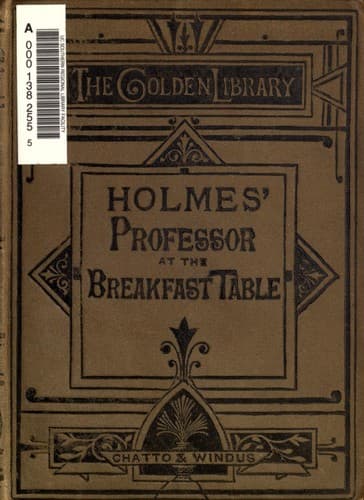
The Professor at the Breakfast-TableHolmes, Oliver Wendell
General
The Professor at the Breakfast-Table
Holmes, Oliver Wendell
American fiction -- 19th century; Conversation -- Fiction; Poetry
That silly little drum they are always beating on, and the trumpet and
the feather they make so much noise and cut such a figure with, we have
not quite outgrown, but play with much less seriously and constantly
than they do. Then there is a whole museum of wigs, and masks, and
lace-coats, and gold-sticks, and grimaces, and phrases, which we laugh
at honestly, without affectation, that are still used in the Old-World
puppet-shows. I don't think we on our part ever understand the
Englishman's concentrated loyalty and specialized reverence. But then we
do think more of a man, as such, (barring some little difficulties about
race and complexion which the Englishman will touch us on presently,)
than any people that ever lived did think of him. Our reverence is a
great deal wider, if it is less intense. We have caste among us, to some
extent; it is true; but there is never a collar on the American wolf-dog
such as you often see on the English mastiff, notwithstanding his
robust, hearty individuality.
This confronting of two civilizations is always a grand sensation to me;
it is like cutting through the isthmus and letting the two oceans swim
into each other's laps. The trouble is, it is so difficult to let out
the whole American nature without its self-assertion seeming to take a
personal character. But I never enjoy the Englishman so much as when he
talks of church and king like Manco Capac among the Peruvians. Then you
get the real British flavor, which the cosmopolite Englishman loses.
How much better this thorough interpenetration of ideas than a barren
interchange of courtesies, or a bush-fighting argument, in which each
man tries to cover as much of himself and expose as much of his opponent
as the tangled thicket of the disputed ground will let him!
--My thoughts flow in layers or strata, at least three deep. I follow
a slow person's talk, and keep a perfectly clear under-current of my
own beneath it. Under both runs obscurely a consciousness belonging to a
third train of reflections, independent of the two others. I will try to
write out a Mental movement in three parts.
A.--First voice, or Mental Soprano,--thought follows a woman talking.
B.--Second voice, or Mental Barytone,--my running accompaniment.
C.--Third voice, or Mental Basso,--low grumble of importunate
self-repeating idea.
A.--White lace, three skirts, looped with flowers, wreath of
apple-blossoms, gold bracelets, diamond pin and ear-rings, the most
delicious berthe you ever saw, white satin slippers--
B.--Deuse take her! What a fool she is! Hear her chatter! (Look out of
window just here.--Two pages and a half of description, if it were
all written out, in one tenth of a second.)--Go ahead, old lady! (Eye
catches picture over fireplace.) There's that infernal family nose! Came
over in the “Mayflower” on the first old fool's face. Why don't they
wear a ring in it?
C.--You 'll be late at lecture,--late at lecture,--late,--late--
Public-domain text, read in full here on John Shaqi.
Reviews
Reviews
No reviews yet
Be the first to share your thoughts on this work.
Join the Discussion
Join the discussion
Sign in to leave a comment or review.
Sign InorCreate an account