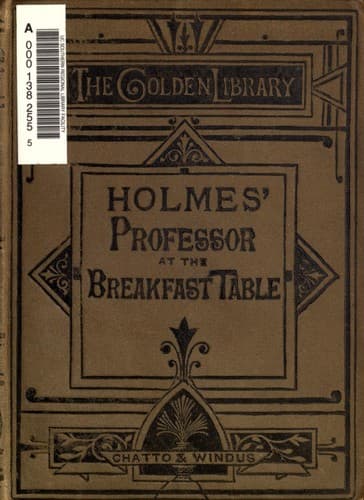
The Professor at the Breakfast-TableHolmes, Oliver Wendell
General
The Professor at the Breakfast-Table
Holmes, Oliver Wendell
American fiction -- 19th century; Conversation -- Fiction; Poetry
You remember, perhaps, in some papers published awhile ago, an odd poem
written by an old Latin tutor? He brought up at the verb amo, I love,
as all of us do, and by and by Nature opened her great living dictionary
for him at the word filia, a daughter. The poor man was greatly
perplexed in choosing a name for her. Lucretia and Virginia were the
first that he thought of; but then came up those pictured stories of
Titus Livius, which he could never read without crying, though he had
read them a hundred times.
--Lucretia sending for her husband and her father, each to bring one
friend with him, and awaiting them in her chamber. To them her wrongs
briefly. Let them see to the wretch,--she will take care of herself.
Then the hidden knife flashes out and sinks into her heart. She
slides from her seat, and falls dying. “Her husband and her father cry
aloud.”--No, not Lucretia.
-Virginius,--a brown old soldier, father of a nice girl. She engaged
to a very promising young man. Decemvir Appius takes a violent fancy to
her,--must have her at any rate. Hires a lawyer to present the arguments
in favor of the view that she was another man's daughter. There used to
be lawyers in Rome that would do such things.--All right. There are two
sides to everything. Audi alteram partem. The legal gentleman has no
opinion,--he only states the evidence.--A doubtful case. Let the young
lady be under the protection of the Honorable Decemvir until it can be
looked up thoroughly.--Father thinks it best, on the whole, to give in.
Will explain the matter, if the young lady and her maid will step this
way. That is the explanation,--a stab with a butcher's knife, snatched
from a stall, meant for other lambs than this poor bleeding Virginia.
The old man thought over the story. Then he must have one look at the
original. So he took down the first volume and read it over. When he
came to that part where it tells how the young gentleman she was engaged
to and a friend of his took up the poor girl's bloodless shape and
carried it through the street, and how all the women followed, wailing,
and asking if that was what their daughters were coming to,--if that
was what they were to get for being good girls,--he melted down into his
accustomed tears of pity and grief, and, through them all, of delight at
the charming Latin of the narrative. But it was impossible to call his
child Virginia. He could never look at her without thinking she had a
knife sticking in her bosom.
Public-domain text, read in full here on John Shaqi.
Reviews
Reviews
No reviews yet
Be the first to share your thoughts on this work.
Join the Discussion
Join the discussion
Sign in to leave a comment or review.
Sign InorCreate an account