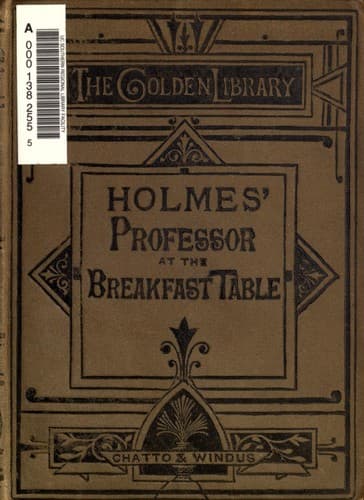
The Professor at the Breakfast-TableHolmes, Oliver Wendell
General
The Professor at the Breakfast-Table
Holmes, Oliver Wendell
American fiction -- 19th century; Conversation -- Fiction; Poetry
I was going to leave the simple reader to wonder over this, taking it
as an unexplained marvel. I think, however, I will turn over a furrow
of subsoil in it.--The explanation is, of course, that in a great many
thoughts there must be a few coincidences, and these instantly arrest
our attention. Now we shall probably never have the least idea of the
enormous number of impressions which pass through our consciousness,
until in some future life we see the photographic record of our thoughts
and the stereoscopic picture of our actions. There go more pieces to
make up a conscious life or a living body than you think for. Why,
some of you were surprised when a friend of mine told you there
were fifty-eight separate pieces in a fiddle. How many “swimming
glands”--solid, organized, regularly formed, rounded disks taking an
active part in all your vital processes, part and parcel, each one of
them, of your corporeal being--do you suppose are whirled along, like
pebbles in a stream, with the blood which warms your frame and colors
your cheeks?--A noted German physiologist spread out a minute drop
of blood, under the microscope, in narrow streaks, and counted the
globules, and then made a calculation. The counting by the micrometer
took him a week.--You have, my full-grown friend, of these little
couriers in crimson or scarlet livery, running on your vital errands
day and night as long as you live, sixty-five billions, five hundred and
seventy thousand millions. Errors excepted.--Did I hear some gentleman
say, “Doubted? “--I am the Professor. I sit in my chair with a petard
under it that will blow me through the skylight of my lecture-room, if I
do not know what I am talking about and whom I am quoting.
Now, my dear friends, who are putting your hands to your foreheads, and
saying to yourselves that you feel a little confused, as if you had been
waltzing until things began to whirl slightly round you, is it possible
that you do not clearly apprehend the exact connection of all that I
have been saying, and its bearing on what is now to come? Listen,
then. The number of these living elements in our bodies illustrates
the incalculable multitude of our thoughts; the number of our thoughts
accounts for those frequent coincidences spoken of; these coincidences
in the world of thought illustrate those which we constantly observe in
the world of outward events, of which the presence of the young girl now
at our table, and proving to be the daughter of an old acquaintance some
of us may remember, is the special example which led me through this
labyrinth of reflections, and finally lands me at the commencement of
this young girl's story, which, as I said, I have found the time and
felt the interest to learn something of, and which I think I can tell
without wronging the unconscious subject of my brief delineation. IRIS.
Public-domain text, read in full here on John Shaqi.
Reviews
Reviews
No reviews yet
Be the first to share your thoughts on this work.
Join the Discussion
Join the discussion
Sign in to leave a comment or review.
Sign InorCreate an account