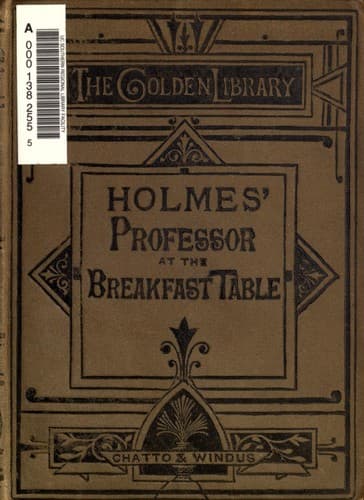
The Professor at the Breakfast-TableHolmes, Oliver Wendell
General
The Professor at the Breakfast-Table
Holmes, Oliver Wendell
American fiction -- 19th century; Conversation -- Fiction; Poetry
Mr. Flournoy, Madam, has obeyed the precept which you have judiciously
delivered. You may be interested, Madam, to know what are the
conclusions at which Mr. J. J. Flournoy of Athens, Georgia, has arrived.
You shall hear, Madam. He has gone to the Bible, and he has come back
from the Bible, bringing a remedy for existing social evils, which, if
it is the real specific, as it professes to be, is of great interest to
humanity, and to the female part of humanity in particular. It is what
he calls TRIGAMY, Madam, or the marrying of three wives, so that “good
old men” may be solaced at once by the companionship of the wisdom of
maturity, and of those less perfected but hardly less engaging qualities
which are found at an earlier period of life. He has followed your
precept, Madam; I hope you accept his conclusions.
The female boarder in black attire looked so puzzled, and, in fact, “all
abroad,” after the delivery of this “counter” of mine, that I left her
to recover her wits, and went on with the conversation, which I was
beginning to get pretty well in hand.
But in the mean time I kept my eye on the female boarder to see what
effect I had produced. First, she was a little stunned at having
her argument knocked over. Secondly, she was a little shocked at the
tremendous character of the triple matrimonial suggestion. Thirdly.--I
don't like to say what I thought. Something seemed to have pleased her
fancy. Whether it was, that, if trigamy should come into fashion, there
would be three times as many chances to enjoy the luxury of saying,
“No!” is more than I, can tell you. I may as well mention that B. F.
came to me after breakfast to borrow the pamphlet for “a lady,”--one of
the boarders, he said,--looking as if he had a secret he wished to be
relieved of.
--I continued.--If a human soul is necessarily to be trained up in the
faith of those from whom it inherits its body, why, there is the end of
all reason. If, sooner or later, every soul is to look for truth with
its own eyes, the first thing is to recognize that no presumption in
favor of any particular belief arises from the fact of our inheriting
it. Otherwise you would not give the Mahometan a fair chance to become a
convert to a better religion.
The second thing would be to depolarize every fixed religious idea in
the mind by changing the word which stands for it.
--I don't know what you mean by “depolarizing” an idea,--said the
divinity-student.
I will tell you,--I said.--When a given symbol which represents a
thought has lain for a certain length of time in the mind, it undergoes
a change like that which rest in a certain position gives to iron. It
becomes magnetic in its relations,--it is traversed by strange forces
which did not belong to it. The word, and consequently the idea it
represents, is polarized.
Public-domain text, read in full here on John Shaqi.
Reviews
Reviews
No reviews yet
Be the first to share your thoughts on this work.
Join the Discussion
Join the discussion
Sign in to leave a comment or review.
Sign InorCreate an account