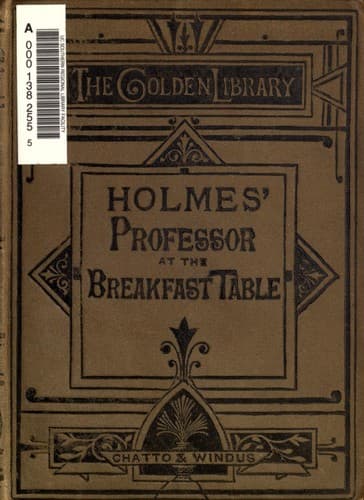
The Professor at the Breakfast-TableHolmes, Oliver Wendell
General
The Professor at the Breakfast-Table
Holmes, Oliver Wendell
American fiction -- 19th century; Conversation -- Fiction; Poetry
The religious currency of mankind, in thought, in speech, and in print,
consists entirely of polarized words. Borrow one of these from another
language and religion, and you will find it leaves all its magnetism
behind it. Take that famous word, O'm, of the Hindoo mythology. Even a
priest cannot pronounce it without sin; and a holy Pundit would shut his
ears and run away from you in horror, if you should say it aloud. What
do you care for O'm? If you wanted to get the Pundit to look at his
religion fairly, you must first depolarize this and all similar words
for him. The argument for and against new translations of the Bible
really turns on this. Skepticism is afraid to trust its truths in
depolarized words, and so cries out against a new translation. I think,
myself, if every idea our Book contains could be shelled out of its old
symbol and put into a new, clean, unmagnetic word, we should have some
chance of reading it as philosophers, or wisdom-lovers, ought to read
it,--which we do not and cannot now any more than a Hindoo can read the
“Gayatri” as a fair man and lover of truth should do. When society has
once fairly dissolved the New Testament, which it never has done yet, it
will perhaps crystallize it over again in new forms of language.
I did n't know you was a settled minister over this parish,--said the
young fellow near me.
A sermon by a lay-preacher may be worth listening--I replied, calmly.
--It gives the parallax of thought and feeling as they appear to the
observers from two very different points of view. If you wish to get
the distance of a heavenly body, you know that you must take two
observations from remote points of the earth's orbit,--in midsummer and
midwinter, for instance. To get the parallax of heavenly truths, you
must take an observation from the position of the laity as well as
of the clergy. Teachers and students of theology get a certain look,
certain conventional tones of voice, a clerical gait, a professional
neckcloth, and habits of mind as professional as their externals. They
are scholarly men and read Bacon, and know well enough what the “idols
of the tribe” are. Of course they have their false gods, as all men that
follow one exclusive calling are prone to do.--The clergy have played
the part of the flywheel in our modern civilization. They have never
suffered it to stop. They have often carried on its movement, when
other moving powers failed, by the momentum stored in their vast body.
Sometimes, too, they have kept it back by their vis inertia, when its
wheels were like to grind the bones of some old canonized error
into fertilizers for the soil that yields the bread of life. But the
mainspring of the world's onward religious movement is not in them, nor
in any one body of men, let me tell you. It is the people that makes
the clergy, and not the clergy that makes the people. Of course, the
profession reacts on its source with variable energy.--But there never
Public-domain text, read in full here on John Shaqi.
Reviews
Reviews
No reviews yet
Be the first to share your thoughts on this work.
Join the Discussion
Join the discussion
Sign in to leave a comment or review.
Sign InorCreate an account