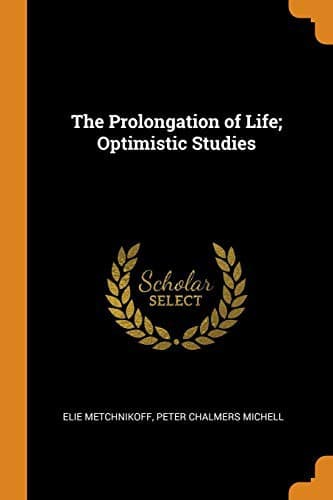
The Prolongation of Life: Optimistic StudiesMetchnikoff, Elie
Science
The Prolongation of Life: Optimistic Studies
Metchnikoff, Elie
Aging; Hygiene; Longevity; Older people -- Social conditions
The appearance of aged persons is too well known to make detailed
description necessary. The skin of the face is dry and wrinkled and
generally pale; the hairs on the head and the body are white; the back
is bent, and the gait is slow and laborious, whilst the memory is weak.
Such are the most familiar traits of old age. Baldness is not a special
character; it often begins during youth and naturally is progressive,
but if it has not already appeared, it does not come on with old age.
The stature diminishes in old age. As the result of a series of
observations, it has been established that a man loses more than an
inch (3·166 cm.), and a woman more than an inch and a half (4·3 cm.),
between the ages of fifty and eighty-five years. In extreme cases,
the loss may be nearly three inches. The weight also becomes less.
According to Quételet, males attain their maximum weights at the age of
forty, females at that of fifty. From the age of sixty years onwards,
the body becomes lighter, the loss at eighty being as much as thirteen
pounds.
Such losses of height and weight are signs of the general atrophy of
the aged organism. Not merely the soft parts, such as the muscles and
viscera, but even the bones lose weight, in the latter case the loss
being of the mineral constituents. This process of decalcification
makes the skeleton brittle, and is sometimes the cause of fatal
accidents.
The loss of muscular tissue is specially great. The volume diminishes,
and the substance becomes paler; the fat between the fibres is
absorbed, and may disappear completely. Movements are slower, and
the muscular force is abated. This progressive degeneration has been
examined by dynamometrical measurements of the hand and the trunk, and
is greater in males than in females.
The volumes and weights of the visceral organs similarly become
smaller, but the diminution is not uniform.
The old age of lower mammals presents characters similar to those found
in man. I can now give other instances than the case of the old dog
which I described in the “Nature of Man.”
I will first take the case of old elephants, described by a competent
observer. “The general appearance is wretched, the skull being often
hardly covered with skin; there are deep abrasions under the eyes, and
smaller ones on the cheeks, whilst the skin of the forehead is very
often deeply fissured or covered with lumps. The eyes are usually dim,
and discharge an abnormal quantity of water. The margin of the ears,
specially on the lower side, is usually frayed. The skin of the trunk
is roughened, hard, and warty, so that the organ has lost much of its
flexibility. The skin on the body generally is worn and wrinkled; the
legs are thinner than in maturity, the huge mass of muscles being much
shrunken, whilst the circumference, especially just above the feet, is
considerably reduced. The skin round the toe-nails is roughened and
frayed. The tail is scaly and hard, and the tip is often hairless.
Public-domain text, read in full here on John Shaqi.
Reviews
Reviews
No reviews yet
Be the first to share your thoughts on this work.
Join the Discussion
Join the discussion
Sign in to leave a comment or review.
Sign InorCreate an account