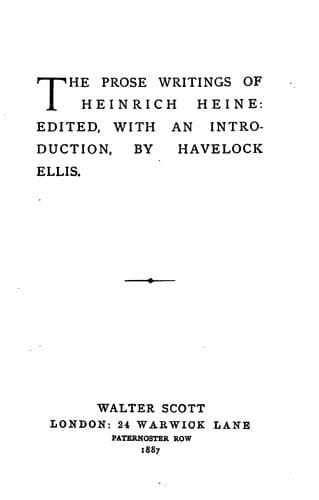
The Prose Writings of Heinrich HeineHeine, Heinrich
General
The Prose Writings of Heinrich Heine
Heine, Heinrich
Heine, Heinrich, 1797-1856 -- Translations into English
...More noteworthy and of more importance than his prose writings are
Luther's poems, the songs which in battle and in trouble blossomed forth
from his heart. Sometimes they resemble a floweret that grows on a rocky
crag, then again a ray of moonlight trembling over a restless sea.
Luther loved music, and even wrote a treatise on the art; hence his
songs are particularly melodious. In this respect he merits the name,
Swan of Eisleben. But he is nothing less than a wild swan in those songs
wherein he stimulates the courage of his followers and inflames himself
to the fiercest rage of battle. A true battle-song was that martial
strain with which he and his companions marched into Worms. The old
cathedral trembled at those unwonted tones, and the ravens, in their
dark nests in the steeple, startled with affright. That song, the
Marseillaise of the Reformation, preserves to this day its inspiriting
power.
...The expressions "classic" and "romantic" refer only to the spirit and
the manner of the treatment. The treatment is classic when the form of
that which is portrayed is quite identical with the idea of the
portrayer, as is the case with the art-works of the Greeks, in which,
owing to this identity, the greatest harmony is found to exist between
the idea and its form. The treatment is romantic when the form does not
reveal the idea through this identity, but lets this idea be surmised
parabolically. (I use the word "parabolically" here in preference to
"symbolically.") The Greek mythology had an array of god-figures, each
of which, in addition to the identity of form and idea, was also
susceptible of a symbolic meaning. But in this Greek religion only the
figures of the gods were clearly defined; all else, their lives and
deeds, was left to the arbitrary treatment of the poet's fancy. In the
Christian religion, on the contrary, there are no such clearly-defined
figures, but stated facts--certain definite holy events and deeds, into
which the poetical faculty of man could place a parabolic signification.
It is said that Homer invented the Greek gods and goddesses. That is not
true. They existed previously in clearly-defined outlines; but he
invented their histories. The artists of the middle ages, on the other
hand, never ventured the least addition to the historical part of their
religion. The fall of man, the incarnation, the baptism, the
crucifixion, and the like, were matters of fact, which were not to be
intermeddled with, and which it was not permissible to remould in the
least, but to which poetry might attach a symbolic meaning. All the arts
during the middle ages were treated in this parabolic spirit, and this
treatment is romantic. Hence we find in the poetry of the middle ages a
mystic universality; the forms are all so shadowy, what they do is so
vaguely indicated, all therein is as if seen through a hazy twilight
intermittently illumined by the moon. The idea is merely hinted at in
Public-domain text, read in full here on John Shaqi.
Reviews
Reviews
No reviews yet
Be the first to share your thoughts on this work.
Elsewhere in the archive
Join the Discussion
Join the discussion
Sign in to leave a comment or review.
Sign InorCreate an account