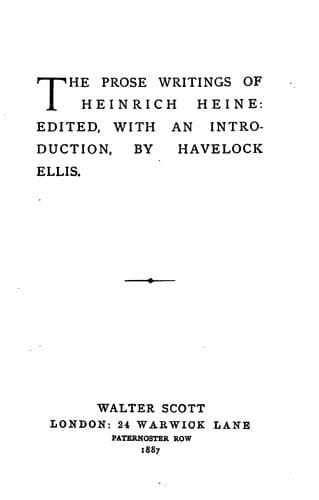
The Prose Writings of Heinrich HeineHeine, Heinrich
General
The Prose Writings of Heinrich Heine
Heine, Heinrich
Heine, Heinrich, 1797-1856 -- Translations into English
the form, as in a riddle; and we dimly see a vague, indefinite figure,
which is the peculiarity of spiritual literature. There is not, as among
the Greeks, a harmony, clear as the sun, between form and meaning, but
occasionally the meaning overtops the given form, and the latter strives
desperately to reach the former, and then we behold bizarre, fantastic
sublimity; then, again, the form has overgrown itself, and is out of all
proportion to the meaning. A silly, pitiful thought trails itself along
in some colossal form, and we witness a grotesque farce: misshapenness
is nearly always the result.
The universal characteristic of that literature was that in all its
productions it manifested the same firm, unshaken faith which in that
period reigned over worldly as well as spiritual matters. All the
opinions of that time were based on authorities. The poet journeyed
along the abysses of doubt as free from apprehension as a mule, and
there prevailed in the literature of that period a dauntless composure
and blissful self-confidence such as became impossible in after-times,
when the influence of the Papacy, the chief of those authorities, was
shattered, and with it all the others were overthrown. Hence the poems
of the middle ages have all the same characteristics, as if composed not
by single individuals, but by the whole people _en masse_: they are
objective, epic, naïve.
In the literature that blossomed into life with Luther we find quite
opposite tendencies.
Its material, its subject, is the conflict between the interests and
views of the Reformation and the old order of things. To the new spirit
of the times, that hodge-podge religion which arose from the two
elements already referred to--Germanic nationality and the
Hindoo-Gnostic Christendom--was altogether repugnant. The latter was
considered heathen idol-worship, which was to be replaced by the true
religion of the Judaic-theistic Gospel. A new order of things is
established; the spirit makes discoveries which demand the well-being of
matter. Through industrial progress and the dissemination of
philosophical theories, spiritualism becomes discredited in popular
opinion. The _tiers-état_ begins to rise; the Revolution already rumbles
in the hearts and brains of men, and what the era feels, thinks, needs,
and wills is openly spoken; and that is the stuff of which modern
literature is made. At the same time the treatment is no longer
romantic, but classic.
Public-domain text, read in full here on John Shaqi.
Reviews
Reviews
No reviews yet
Be the first to share your thoughts on this work.
Elsewhere in the archive
Join the Discussion
Join the discussion
Sign in to leave a comment or review.
Sign InorCreate an account