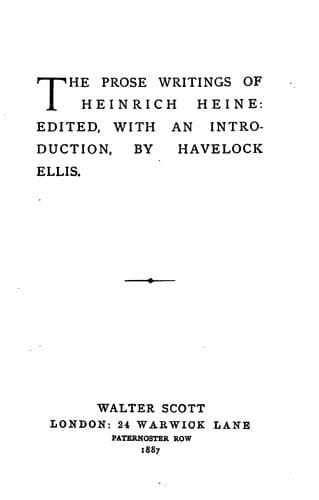
The Prose Writings of Heinrich HeineHeine, Heinrich
General
The Prose Writings of Heinrich Heine
Heine, Heinrich
Heine, Heinrich, 1797-1856 -- Translations into English
...No German can pronounce the name of Lessing without a responsive echo
in his breast. Since Luther, Germany has produced no greater and better
man than Gotthold Ephraim Lessing. These two are our pride and joy. In
the troubles of the present we look back at their consoling figures, and
they answer with a look full of bright promise. The third man will come
who will perfect what Luther began and what Lessing carried on--the
third Liberator.
Like Luther, Lessing's achievements consisted not only in effecting
something definite, but in agitating the German people to its depths,
and in awakening through his criticism and polemics a wholesome
intellectual activity. He was the vivifying critic of his time, and his
whole life was a polemic. His critical insight made itself felt
throughout the widest range of thought and feeling--in religion, in
science, and in art. His polemics vanquished every opponent, and grew
stronger with every victory. Lessing, as he himself confessed, needed
conflict for the full development of his powers. He resembled that
fabulous Norman who inherited the skill, knowledge, and strength of
those whom he slew in single combat, and in this manner became finally
endowed with all possible excellencies and perfections. It is easily
conceivable that such a contentious champion should stir up not a little
commotion in Germany,--in that quiet Germany which was then even more
sabbatically quiet than now. The majority were stupefied at his literary
audacity. But this was of the greatest assistance to him, for _oser_!
is the secret of success in literature, as it is in revolutions,--and in
love. All trembled before the sword of Lessing. No head was safe from
him. Yes, many heads he struck off from mere wantonness, and was
moreover so spiteful as to lift them up from the ground and show to the
public that they were hollow inside. Those whom his sword could not
reach he slew with the arrows of his wit. His friends admired the pretty
feathers of those arrows; his enemies felt their barbs in their hearts.
Lessing's wit does not resemble that _enjouement_, that _gaîté_, those
lively _saillies_, which are so well known here in France. His wit was
no petty French greyhound, chasing its own shadow: it was rather a great
German tom-cat, who plays with the mouse before he throttles it.
Public-domain text, read in full here on John Shaqi.
Reviews
Reviews
No reviews yet
Be the first to share your thoughts on this work.
Elsewhere in the archive
Join the Discussion
Join the discussion
Sign in to leave a comment or review.
Sign InorCreate an account