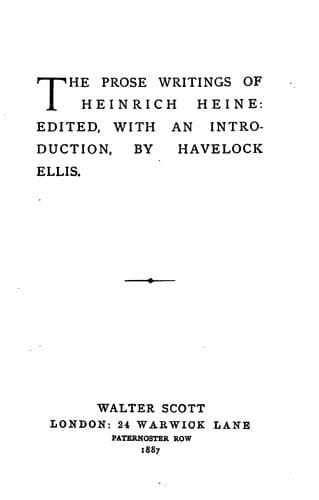
The Prose Writings of Heinrich HeineHeine, Heinrich
General
The Prose Writings of Heinrich Heine
Heine, Heinrich
Heine, Heinrich, 1797-1856 -- Translations into English
...Lessing was the prophet who from the New Testament pointed towards
the Third Testament. I have called him the successor of Luther; and it
is in this character that I have to speak of him here. Of his influence
on German art I shall speak hereafter. On this he effected a wholesome
reform, not only through his criticism, but also through his example;
and this latter phase of his activity is generally made the most
prominent, and is the most discussed. But, viewed from our present
standpoint, his philosophical and theological battles are to us more
important than all his dramas, or his dramaturgy. His dramas, however,
like all his writings, have a social import, and _Nathan the Wise_ is in
reality not only a good play, but also a philosophical, theological
treatise in support of the doctrine of a pure theism. For Lessing, art
was a tribune, and when he was thrust from the pulpit or the professor's
chair he sprang on to the stage, speaking out more boldly, and gaining a
more numerous audience.
I say that Lessing continued the work of Luther. After Luther had freed
us from the yoke of tradition and had exalted the Bible as the only
well-spring of Christianity, there ensued a rigid word-service, and the
letter of the Bible ruled just as tyrannically as once did tradition.
Lessing contributed the most to the emancipation from the tyranny of the
letter.
Lessing died in Brunswick, in the year 1781, misunderstood, hated, and
denounced. In the same year there was published at Königsberg the
_Critique of Pure Reason_, by Immanuel Kant. With this book there begins
in Germany an intellectual revolution, which offers the most wonderful
analogies to the material revolution in France, and which to the
profound thinker must appear equally important. It develops the same
phases, and between the two there exists a very remarkable parallelism.
On both sides of the Rhine we behold the same rupture with the past: it
is loudly proclaimed that all reverence for tradition is at an end. As
in France no privilege, so in Germany no thought is tolerated without
proving its right to exist: nothing is taken for granted. And as in
France fell the monarchy, the keystone of the old social system, so in
Germany fell theism, the keystone of the intellectual _ancien régime_.
* * * * *
Public-domain text, read in full here on John Shaqi.
Reviews
Reviews
No reviews yet
Be the first to share your thoughts on this work.
Elsewhere in the archive
Join the Discussion
Join the discussion
Sign in to leave a comment or review.
Sign InorCreate an account