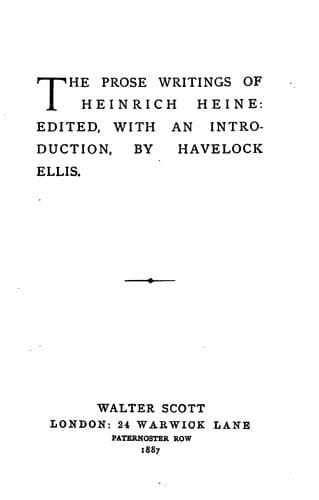
The Prose Writings of Heinrich HeineHeine, Heinrich
General
The Prose Writings of Heinrich Heine
Heine, Heinrich
Heine, Heinrich, 1797-1856 -- Translations into English
At that time I was of the opinion that the ridiculousness of Don
Quixotism consisted in the fact that the noble knight endeavoured to
recall a long-perished past back to life, and his poor limbs and back
came into painful contact with the harsh realities of the present.
Alas! I have since learned that it is an equally ungrateful folly to
endeavour to bring the future prematurely into the present, and that for
such an assault upon the weighty interests of the day, one possesses but
a very sorry steed, a brittle armour, and an equally frail body! And the
wise man dubiously shakes his sage head at the one, as well as at the
other, of these Quixotisms. But Dulcinea del Toboso is still the most
beautiful woman in the world; although I lie stretched upon the earth,
helpless and miserable, I will never take back that assertion, I cannot
do otherwise--on with your lances, ye Knights of the Silver Moon, ye
disguised barbers!
What leading idea guided Cervantes when he wrote his great book? Was his
purpose merely the destruction of the romances of knight-errantry, the
reading of which at that time was so much the rage in Spain that both
clerical and secular ordinances against them were powerless? Or did he
seek to hold up to ridicule all manifestations of human enthusiasm in
general, military heroism in particular? Ostensibly he aimed only to
satirise the romances above referred to, and through the exposition of
their absurdities deliver them over to universal derision, and thus put
an end to them. In this he succeeded most brilliantly; for that which
neither the exhortations from the pulpit, nor the threats of the
authorities could effect, that a poor writer accomplished with his pen.
He destroyed the romances of chivalry so effectually that soon after the
appearance of _Don Quixote_ the taste for that class of literature
wholly died out in Spain, and no more of that order were printed. But
the pen of a man of genius is always greater than he himself; it extends
far beyond his temporary purpose, and without being himself clearly
conscious of it, Cervantes wrote the greatest satire against human
enthusiasm. He had not the least presentiment of this, for he himself
was a hero, who had spent the greater portion of his life in chivalrous
conflicts, and who in his old age was wont to rejoice that he had
participated in the battle of Lepanto, although he paid for this glory
with the loss of his left hand.
The biographers can tell us but little concerning the person or private
life of the poet who wrote _Don Quixote_. We do not lose much by the
omission of such details, which are generally picked up from the female
gossips of the neighbourhood. They see only the outer shell; but we see
the man, his true, sincere, unslandered self.
Public-domain text, read in full here on John Shaqi.
Reviews
Reviews
No reviews yet
Be the first to share your thoughts on this work.
Elsewhere in the archive
Join the Discussion
Join the discussion
Sign in to leave a comment or review.
Sign InorCreate an account