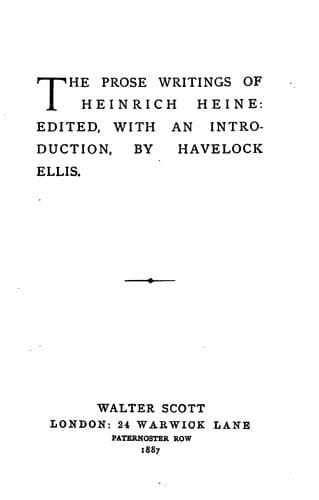
The Prose Writings of Heinrich HeineHeine, Heinrich
General
The Prose Writings of Heinrich Heine
Heine, Heinrich
Heine, Heinrich, 1797-1856 -- Translations into English
He was a handsome, powerful man, Don Miguel Cervantes de Saavedra. He
had a high forehead, and a large heart. His eyes possessed a wonderful
magic; just as there are people who can look into the earth, and see the
hidden treasures and the dead that lie buried there, so the eye of the
great poet could penetrate the breasts of men, and see distinctly all
that was concealed there. To the good his look was as a ray of sunlight
gladdening and illuminating the heart; to the bad his glance was a
sword, sharply piercing their souls. His searching eyes penetrated to
the very soul of a person, and questioned it, and if it refused to
answer, he put it to the torture, and the soul lay stretched bleeding on
the rack, while perhaps the body assumed an air of condescending
superiority. Is it to be wondered at that many formed a dislike for him,
and gave him but scant assistance in his journey through life? He never
achieved rank or position, and from all his toilsome pilgrimages he
brought back no pearls, but only empty shells. It is said that he could
not appreciate the value of money, but I assure you he fully appreciated
its worth when he had no more. But he never prized it as highly as he
did his honour. He had debts, and in one of his writings, in which
Apollo is supposed to grant to the poets a charter of privileges, the
first paragraph declares: When a poet says he has no money, his simple
assurance shall suffice, and no oath shall be required of him. He loved
music, flowers, and women, but in his love for the latter he sometimes
fared very badly, particularly in his younger days. Did the
consciousness of future greatness console him, when pert young roses
stung him with their thorns?--Once on a bright summer afternoon, while
yet a young gallant, he walked along the banks of the Tagus in company
with a pretty girl of sweet sixteen, who continually mocked at his
tender speeches. The sun had not yet set, it still glowed with all its
golden splendour, but high up in the heavens was the moon, pale and
insignificant, like a little white cloud. "See'st thou," said the young
poet to his sweetheart, "see'st thou yonder small pale disk? The river
by our side in which it mirrors itself seems to receive its pitiful
reflex on its proud bosom merely out of compassion, and the curling
billows at times cast it disdainfully aside towards the shore. But wait
until day fades into twilight; as soon as darkness descends, yonder pale
orb will grow brighter and brighter, and will flood the whole stream
with its silvery light, and the haughty billows that before were so
scornful will then tremble with ecstasy at sight of the lovely moon, and
roll rapturously towards it."
Public-domain text, read in full here on John Shaqi.
Reviews
Reviews
No reviews yet
Be the first to share your thoughts on this work.
Elsewhere in the archive
Join the Discussion
Join the discussion
Sign in to leave a comment or review.
Sign InorCreate an account