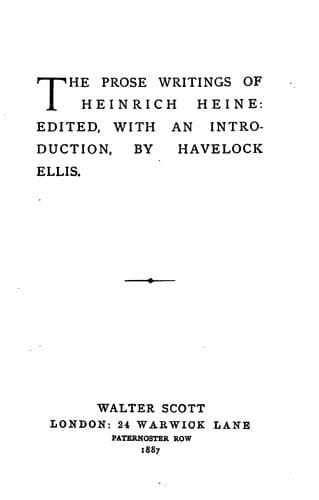
The Prose Writings of Heinrich HeineHeine, Heinrich
General
The Prose Writings of Heinrich Heine
Heine, Heinrich
Heine, Heinrich, 1797-1856 -- Translations into English
this day always keep him in view as a model. These English novelists
since Richardson's reign are prosaic natures; to the prudish spirit of
their time even pithy descriptions of the life of the common people are
repugnant, and we see on yonder side of the channel those _bourgeois_
novels arise, wherein the petty, humdrum life of the middle classes is
depicted. The public were surfeited with this deplorable class of
literature until recently, when appeared the great Scot, who effected a
revolution, or rather a restoration, in novel-writing. As Cervantes
introduced the democratic element into romance, at a time when one-sided
knight-errantry ruled supreme, so Walter Scott restored the aristocratic
element to romance when it had wholly disappeared, and only a prosaic
bourgeoisie was to be found there. By an opposite course Walter Scott
again restored to romance that beautiful symmetry which we admire in
Cervantes's _Don Quixote_.
I believe that the merits of England's second great poet have never in
this respect been recognised. His Tory proclivities, his partiality for
the past, were wholesome for literature, and for those masterpieces of
his genius that everywhere found favour and imitators, and which drove
into the darkest corners of the circulating libraries those ashen-grey,
ghostly remains of the _bourgeoisie_ romances. It is an error not to
recognise Walter Scott as the founder of the so-called Historical
Romance, and to endeavour to trace the latter to German initiative. This
error arises from the failure to perceive that the characteristic
feature of the Historical Romance consists just in the harmony between
the aristocratic and democratic elements, and that Walter Scott, through
the re-introduction of the aristocratic element, most beautifully
restored that harmony which had been overthrown during the absolutism of
the democratic element, whereas our German romanticists eliminated the
democratic element entirely from their novels, and returned again to the
ruts of those crazy romances of knight-errantry that flourished before
Cervantes. Our De la Motte-Fouqué is only a straggler from the ranks of
those poets who gave to the world _Amadis de Gaul_, and similar
extravagant absurdities. I admire not only the talent, but also the
courage of the noble Baron who, two centuries after the appearance of
_Don Quixote_, has written his romances of chivalry. It was a peculiar
period in Germany when the latter appeared and found favour with the
public. What was the significance in literature of that partiality for
knight-errantry, and for those pictures of the old feudal times? I
believe that the German people desired to bid an eternal farewell to the
middle ages, but moved with emotion as we Germans are so apt to be, we
took our leave with a kiss. For the last time we pressed our lips to the
old tombstone. True, some of us behaved in a very silly manner on that
occasion. Ludwig Tieck, the smallest boy in school, dug the dead
Public-domain text, read in full here on John Shaqi.
Reviews
Reviews
No reviews yet
Be the first to share your thoughts on this work.
Elsewhere in the archive
Join the Discussion
Join the discussion
Sign in to leave a comment or review.
Sign InorCreate an account