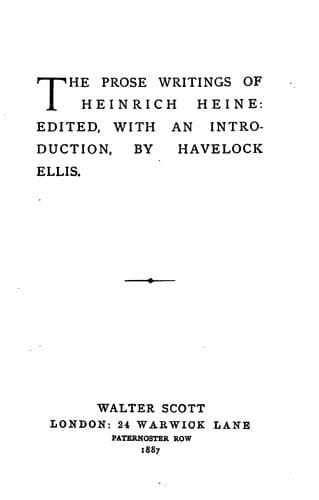
The Prose Writings of Heinrich HeineHeine, Heinrich
General
The Prose Writings of Heinrich Heine
Heine, Heinrich
Heine, Heinrich, 1797-1856 -- Translations into English
From the newspapers and letters that reach me I learn how widely this
report has won credence; and I fall into a painful embarrassment when I
think of the sincere, loving joy which is so touchingly expressed in
some of these epistles. Travellers tell me that the salvation of my soul
has even furnished a theme for pulpit eloquence. Young Catholic priests
seek permission to dedicate to me the first fruits of their pen. I am
regarded as a shining light--that is to be--of the Church. This pious
folly is so well meant and sincere that I cannot laugh at it. Whatever
may be said of the zealots of Catholicism, one thing is certain: they
are no egotists; they take a warm interest in their fellow-men--alas!
often a little too warm an interest. I cannot ascribe that false report
to malice, but only to mistake. The innocent facts were in this case
surely distorted by accident only. The statement of time and place is
quite correct. I was really in the designated church on the designated
day, and I did there undergo a religious ceremony; but this ceremony was
no hateful abjuration, but a very innocent conjugation. In short, after
being married according to the civil law, I also invoked the sanction of
the Church, because my wife, who is a strict Catholic, would not have
considered herself properly married in the eyes of God without such a
ceremony; and for no consideration would I shake this dear being's
belief in the religion which she has inherited.
It is well, moreover, that women should have a positive religion.
Whether there is more fidelity among wives of the evangelic faith, I
shall not attempt to discuss. But the Catholicism of the wife certainly
saves the husband from many annoyances. When Catholic women have
committed a fault, they do not secretly brood over it, but confess to
the priest, and as soon as they have received absolution they are again
as merry and light-hearted as before. This is much pleasanter than
spoiling the husband's good spirits or his soup by downcast looks or
grieving over a sin for which they hold themselves in duty bound to
atone during their whole lives by shrewish prudery and quarrelsome
excess of virtue. The confessional is likewise useful in another
respect. The sinner does not keep her terrible secret preying on her
mind; and since women are sure, sooner or later, to babble all they
know, it is better that they should confide certain matters to their
confessor than that they should, in some moment of overpowering
tenderness, talkativeness, or remorse, blurt out to the poor husband the
fatal confession.
Public-domain text, read in full here on John Shaqi.
Reviews
Reviews
No reviews yet
Be the first to share your thoughts on this work.
Elsewhere in the archive
Join the Discussion
Join the discussion
Sign in to leave a comment or review.
Sign InorCreate an account