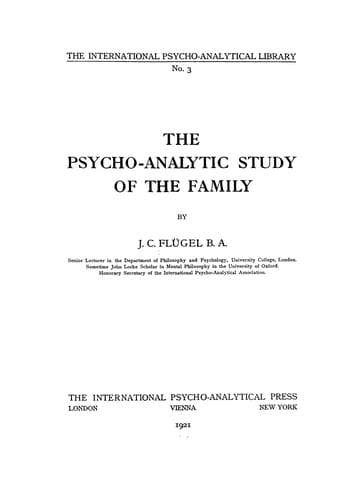
The psycho-analytic study of the familyFlugel, J. C. (John Carl)
Science
The psycho-analytic study of the family
Flugel, J. C. (John Carl)
Families; Marriage; Parent and child; Psychoanalysis
Freud has drawn attention to the occurrence of a curious case of
displacement--not infrequent among men and of very considerable importance
for subsequent sexual life--which seems to depend to some extent at any
rate, upon an arrest in the Unconscious at the stage of secondary mother
hatred or contempt to which we referred on p. 59[129]. In such cases
the mother is not pitied for having to suffer unwelcome advances from
the father, but hated and despised for permitting or encouraging these
advances. The father, being, according to the estimation of the child's
Unconscious, a partner altogether undesirable, one who would under no
circumstances be preferred to the child himself by any woman of good
taste, the mother is regarded as a person quite lacking in such taste, a
woman who indeed might give herself to _anybody_ (a view which of course
also encourages the hope that she may some day give herself to the child).
If this view should persist in the Unconscious, the mother may come
subsequently to be regarded as a sort of _prostitute_.
[Sidenote: The dissociation of sexual attractiveness and esteem]
Now although such a sequence of ideas in the Unconscious may lead to
contempt of the mother, it has not deprived her of her original power of
attracting love and admiration; it leads rather to a mental splitting up
of these original attractive attributes, the more purely and directly
sexual ones being separated from the other characteristics in virtue
of which she stands as an example of all that is morally desirable in
womanhood. These two different aspects of the mother attributes are then
in later life sought and found in different individuals--the sexual
attributes in prostitutes or in women of inferior morality, education,
intelligence or social station; the other attributes--objects of tender
love and admiration--in women of a higher standing, towards whom however
no physically sexual attraction can be felt.
[Sidenote: The importance of this dissociation]
This dissociation of purely sexual attraction from tenderness, esteem
and the other components of fully developed love, is, if we take account
of its presence in minor as well as in major degrees, of such frequent
occurrence, that it has been regarded by some as a normal feature of the
sex impulse in the human male. It is at the same time a feature which
cannot but be productive of harm in a monogamous society, so that if
Freud's explanation of its origin should prove to be one that is at all
generally valid, this aberrant process of development must be regarded as
one that entails very serious consequences of an ethical and sociological
as well as of a psychological nature, and one therefore to whose
incidence, genesis, growth and history a little further consideration may
perhaps not unprofitably be devoted here.
[Sidenote: Influences in later life which are liable to reinforce it]
Public-domain text, read in full here on John Shaqi.
Reviews
Reviews
No reviews yet
Be the first to share your thoughts on this work.
Elsewhere in the archive
Join the Discussion
Join the discussion
Sign in to leave a comment or review.
Sign InorCreate an account