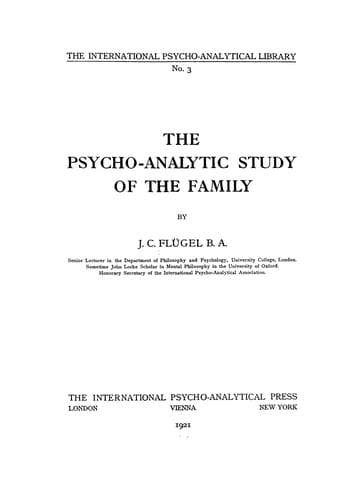
The psycho-analytic study of the familyFlugel, J. C. (John Carl)
Science
The psycho-analytic study of the family
Flugel, J. C. (John Carl)
Families; Marriage; Parent and child; Psychoanalysis
of the divine mother. In the early days of the Church there are accounts
and rumours of sects which endeavoured to establish the worship of Mary
alongside that of the Father and the Son, and there is evidence to show
that the notion of the Holy Ghost corresponds in one of its aspects to
that of a female deity who completes the natural trinity of Father, Mother
and Son[181]. In the Roman Church Mary, as the mother of Christ, has
received a widespread and often profound (though to some extent of course
unofficial) adoration, being regarded perhaps especially as the helper in
time of trouble, to whom men and women may go for comfort, protection,
guidance or forgiveness in just the same way as they did to their earthly
mother in their childhood: an adoration which has tended to call forth a
feeling of disgust and horror in the Protestant Church, in which the more
primite Christian tradition of the repression of the mother-regarding
feelings has in this respect been kept alive[182].
[Sidenote: The Immaculate Conception]
The doctrine of the Immaculate Conception, which has played such a
prominent part in Christian theology and theological discussion, is
of course only one of the many similar instances of the notion of the
supernatural birth[183]. Like many of these other instances, it is due,
not merely to the fact of its being a relic from a time when there was
little certainty or knowledge as to the nature of paternity, but to the
fact that it constitutes an active expression of a strong (though usually
unconscious) wish--a wish that is compounded from a number of separate,
though of course related, elements, of which the chief are perhaps the
following:--(1) the desire for "purity" on the part of the mother, in
order that she may belong to the revered rather than to the sexually
attractive but despised group of women (_cp._ above p. 110)--a desire
which at the same time purifies the mother-regarding love of its grosser
elements and renders it less liable to repression; (2) the desire to be
independent of the father and to owe nothing to him (_cp._ above p. 109);
(3) a desire to avoid sexual jealousy of the father together with the
envy, hostility or contempt that would inevitably--especially in view of
the general Christian attitude towards sex--accompany the notion of the
father as a sexually active being. These factors combine to make the idea
of sexual relations between the parents one that is peculiarly distasteful
to their children, particularly when it is a question not of ordinary
human parents with their admitted imperfections but of their heavenly and
perfected counterparts, and the doctrine of the Immaculate Conception
satisfactorily removes the necessity for this idea[184].
[Sidenote: Open depiction of the parents and of the Œdipus complex in
primitive religions]
Public-domain text, read in full here on John Shaqi.
Reviews
Reviews
No reviews yet
Be the first to share your thoughts on this work.
Elsewhere in the archive
Join the Discussion
Join the discussion
Sign in to leave a comment or review.
Sign InorCreate an account