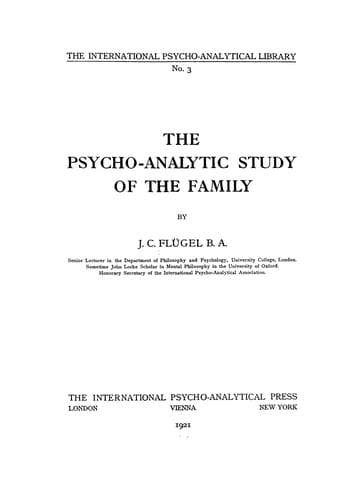
The psycho-analytic study of the familyFlugel, J. C. (John Carl)
Science
The psycho-analytic study of the family
Flugel, J. C. (John Carl)
Families; Marriage; Parent and child; Psychoanalysis
children, while the children are in their turn often not backward in their
manifestations of love and respect. Parents in civilised communities, on
the other hand, have often shown themselves (under a veneer of kindness
or consideration) singularly brutal and selfish in the treatment of their
children; the latter not infrequently manifesting a corresponding lack of
genuine affection for their parents. Under these circumstances it would
seem that we are perhaps justified in attributing the undoubted increase
in the repression of the hate attitude to the more efficient operation
of the "moral" factors, rather than to any growth of tenderness between
parent and child which might have served more effectually to counter-act
the hostile tendencies.
FOOTNOTES:
[Footnote 216: Though we ought possibly to make an exception here in the
case of that fear which seems to arise as the result of a transformation
of sexual impulses. On the other hand, it is possible that this too may
be brought under the more general formula, if we recognise that the fear
is in this case directed not to some outer object but to some threatening
element within the mind. For a discussion of this matter see Freud,
"Vorlesungen zur Einführung in die Psychoanalyse," 466 ff. For a most
important discussion of the fundamental nature and conditions of love and
hate and of the different causes from which they originate, see Freud,
"Sammlung kleiner Schriften zur Neurosenlehre," IV, 270 ff.]
[Footnote 217: W. Wundt, "Elements of Folk Psychology," trans. by E. L.
Schaub, 1916, 116 ff.]
[Footnote 218: It is of course true that with a system of group marriage
the opportunities for sexual relations among young people may sometimes
be no greater than under monogamy, since all the available women may be
regarded as belonging exclusively to a certain class of men--usually those
who have attained a certain age. The hatred and jealousy aroused in the
young men towards their elders may in such cases be equal in intensity
to those felt under monogamic conditions, but the fact remains that this
hatred is no longer intimately connected with the _family_ (at any rate as
we understand that institution at the present day).]
[Footnote 219: Wundt. _Op. cit._ 34 ff.]
[Footnote 220: Wundt. _Op. cit._ 311 ff.]
[Footnote 221: This is of course specially the case where the moral code
upheld by the parents is one of unnecessary or extreme severity, in
which almost every natural manifestation of youthful joy, or vitality
is condemned; as is sometimes the case, for instance, with parents of
an ultra-puritanical way of thinking, whose own mental life, however
admirable in other respects, has been warped by excessive inhibitions.
Although marked perhaps by less bitterness than is usual in such cases,
Edmund Gosse's remarkable work "Father and Son" affords much interesting
ground for thought in this connection.]
Public-domain text, read in full here on John Shaqi.
Reviews
Reviews
No reviews yet
Be the first to share your thoughts on this work.
Elsewhere in the archive
Join the Discussion
Join the discussion
Sign in to leave a comment or review.
Sign InorCreate an account