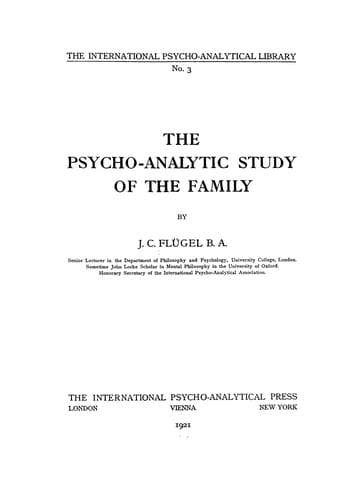
The psycho-analytic study of the familyFlugel, J. C. (John Carl)
Science
The psycho-analytic study of the family
Flugel, J. C. (John Carl)
Families; Marriage; Parent and child; Psychoanalysis
What we have here said as regards the necessity for the gradual relaxation
of parental control applies of course not only to the parents themselves
but to their substitutes--guardians, nurses, teachers and others who
are placed in similar positions of trust and authority. There is indeed
reason to believe that in these quarters the necessity of emancipation is
often more in need of emphasis than among actual parents. Particularly
is this the case with regard to certain institutions, where children
would seem to be brought up with but little freedom or opportunity to
learn the nature and conditions of autonomy or to adapt themselves to
the varied circumstances of the outer world. In many of our schools also
there is to some extent a lack of proper understanding or application
of the principles which demand the gradual relaxation of parental and
quasi-parental authority. Though here, as a rule, the evil is in practice
less serious than it would at first appear to be; the granting of
autonomy and the cultivation of responsibility and self-control in some
directions usually compensating in large measure for the petty and foolish
restrictions to which adolescent boys and girls, or even fully grown
young men and women, are subjected in some of our larger and better known
educational establishments.
[Sidenote: The ethics of the family must however be brought into
connection with wider social questions]
These last considerations point the way to certain wider issues that are
connected with the ethics of the family--issues with which we have already
been brought face to face in Chapters XIII and XIV, and which we need
therefore only refer to here by way of recapitulation. We have seen in
these chapters that there exists a correlation between certain aspects
or stages of development of the family on the one hand and certain forms
of social or ethical institutions or organizations--particularly in the
sphere of education, politics and religion--upon the other. Inasmuch
as the attitude of the individual towards his teacher, his social or
political superior, or his God, is to a very considerable extent derived
from, and dependent on, that of the child towards his parent (the former
attitude being a displacement of the latter), it is obvious that moral
considerations and decisions with regard to the relationship of parent and
child cannot altogether be divorced from the wider questions involved in
the relations of the individual to his religious, social, and educational
environment.
[Sidenote: Our ethical conclusions in the two cases must harmonise with
one another]
Public-domain text, read in full here on John Shaqi.
Reviews
Reviews
No reviews yet
Be the first to share your thoughts on this work.
Elsewhere in the archive
Join the Discussion
Join the discussion
Sign in to leave a comment or review.
Sign InorCreate an account