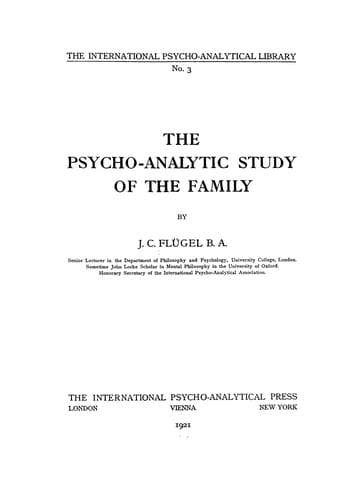
The psycho-analytic study of the familyFlugel, J. C. (John Carl)
Science
The psycho-analytic study of the family
Flugel, J. C. (John Carl)
Families; Marriage; Parent and child; Psychoanalysis
Thus it would be, in the main, a foolish and useless proceeding to urge,
as we have done, the desirability of a gradual emancipation of the growing
child from the controlling and protecting influences of the parents,
unless we are at the same time willing to permit a corresponding growth
of autonomy in school and college. Again, if we were right in assuming a
connection, on the one hand between a highly developed _patria potestas_
and a relatively stable and unprogressive political condition, and on
the other between the relaxation of parental authority and a state of
rapid political development and loosening of governmental authority,
then it would (in the absence of any counteracting influence) be absurd
to demand the complete emancipation of the individual from his family,
if at the same time we desired to uphold autocracy in government or to
increase the stability of political and social forms. Nor, once more,
would the encouragement of children to become independent of their
fathers be logically compatible with the maintenance of a religion of
the Judaic type, in which the severe and all-powerful Father-God is but
a displacement of an earthly father whose stem authority is unquestioned
within the bounds of his own family. It must be realised that our attitude
in the one case must be brought into harmony with our views in the other.
Our ultimate conclusions as to what is desirable within the family
must be arrived at only after due consideration of their wider outside
bearings; and again, our opinions on these wider issues may profitably be
reviewed in the light of the knowledge that is gained by a biological and
psychological study of the family.
[Sidenote: The extent of this harmony]
In the present pages we have followed in the main the latter course.
Nevertheless it would appear that on the whole the conclusions we have
arrived at by this method are not in any way seriously incompatible with
the general tendencies of contemporary thought. While recognising the
necessity and desirability of the family influences in early life, we
have for the most part demanded emancipation of the individual from
any such growth and retention of these influences as would be liable to
hamper or delay his personal development. This is well in harmony with the
tendencies which are manifested nowadays towards freedom in education,
with the analogous tendencies aiming at the overthrow of autocracy and the
establishment of democracy in politics and with the growing toleration and
increasing abandonment of the Judaic attitude in religion.
[Sidenote: in education]
In education there would seem to be almost complete agreement between
the implications of our own conclusions and all the more modern and
progressive tendencies in discipline and teaching; it is only with the
antiquated remains of systems that are now universally condemned by all
reformers that there remain any serious elements of conflict.
[Sidenote: in religion]
Public-domain text, read in full here on John Shaqi.
Reviews
Reviews
No reviews yet
Be the first to share your thoughts on this work.
Elsewhere in the archive
Join the Discussion
Join the discussion
Sign in to leave a comment or review.
Sign InorCreate an account