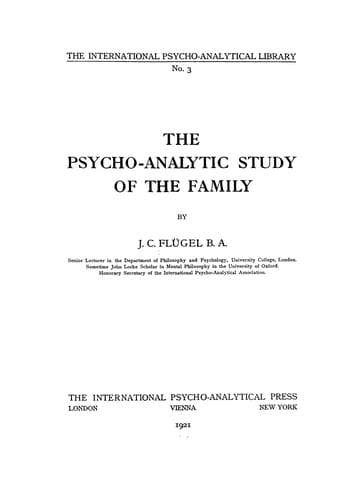
The psycho-analytic study of the familyFlugel, J. C. (John Carl)
Science
The psycho-analytic study of the family
Flugel, J. C. (John Carl)
Families; Marriage; Parent and child; Psychoanalysis
In religion the agreement is also very considerable, though perhaps less
thoroughgoing; there are perhaps many who would still retain the notion of
a quasi-anthropomorphic Father-God as an extra-mental reality, even though
the purely mental origin of such a God has become apparent.
[Sidenote: in politics]
It is in politics however that such discrepancy as there exists is
perhaps most apparent. Although the primitive political father--the
autocrat--would seem to be rapidly disappearing, it is fairly clear that
there exists a tendency to resurrect some of the parental attributes and
give them a political application by bestowing them upon the State. The
world-war has taught us the necessity of implicit obedience to the State
and its representatives--military and civil; the right of independent
thought, action and criticism being to a large extent suspended and the
minute details of our lives being subject to order and inspection in much
the same way as in our childhood they were subject to the supervision of
our parents. Again, modern socialistic thought--especially in its cruder
aspects--has produced a state of mind, as a result of which the individual
becomes to a large extent absolved from the responsibility for his own
education, progress and maintenance, or for those of his children. The
adult individual is thus led to transfer on to the State that attitude
of dependence which he originally adopted in relation to his parents,
failing to this extent to attain that full degree of self-reliance
and independence which we have had in view in considering the gradual
emancipation of children from their parents. In these respects it would
seem that the conclusions arrived at in the course of our study of the
family would point to a rather larger measure of Individualism than is
contemplated by the great body of contemporary political thought. If our
conclusions are correct, there is a danger in too wide a ramification of
state provision and state control, inasmuch as it is liable to prevent
that full development of individual power, initiative and self-reliance
which can only be obtained by a high degree of emancipation from the
primitive attitude of dependence on the parents. If, on the other hand,
it is considered that the advantages of a far-reaching and complex
state organization override those attending the full development of
individuality, it is obvious that our ethical conclusions with regard to
the family may have to be correspondingly revised.
[Sidenote: The individual's relations to his family in later life]
[Sidenote: They must be capable of being broken altogether]
[Sidenote: though it is natural that some relationship should be
maintained]
Public-domain text, read in full here on John Shaqi.
Reviews
Reviews
No reviews yet
Be the first to share your thoughts on this work.
Elsewhere in the archive
Join the Discussion
Join the discussion
Sign in to leave a comment or review.
Sign InorCreate an account