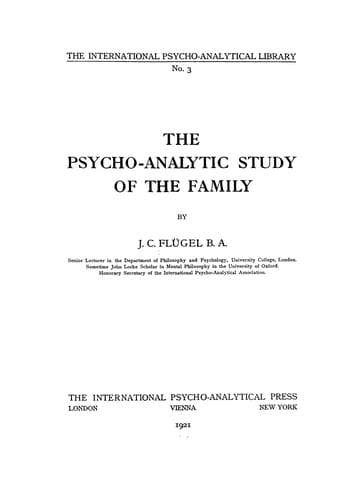
The psycho-analytic study of the familyFlugel, J. C. (John Carl)
Science
The psycho-analytic study of the family
Flugel, J. C. (John Carl)
Families; Marriage; Parent and child; Psychoanalysis
We must remember, however, that there very often _are_ reasons to the
contrary. In many cases, for instance, the love or dependence fixations
in an individual's mind are such that continued intimacy with the parents
will seriously detract from that individual's capacity to make the best
of life. Frequent meeting with the parents may sap his energy or deprive
him of initiative and self-reliance in the manner we have studied: or
again, it may cause serious interference with his love life, as where
the constant arousal of the not wholly outgrown love impulses to father
or mother may appreciably diminish the affection available for husband
or wife respectively, thus producing an unhappy marriage. For similar
reasons frequent meetings between brothers and sisters may often be
disadvantageous. Still more clearly is it undesirable to continue family
intimacies where not love but hatred is the predominant tendency aroused
and fostered by these intimacies. In such cases it is evident hypocrisy
for the parties concerned to meet more often than is absolutely necessary:
the frequent stirring up of conscious or unconscious hatred can only cause
unhappiness, unprofitable and dangerous mental conflict or deterioration
of character; and the more that relatives who are unable to "get on" with
one another keep apart, the better it will be for all concerned.
With these wide and sweeping reservations however, it would probably
seem to accord best with psychological and sociological considerations
if at any rate some moderate degree of connection be maintained between
relatives, whom circumstances have not definitely set apart. Given
freedom from all undesirable fixations (whether of hatred or of love),
brothers and sisters have at least as good reasons for being permanently
helpful and agreeable to one another as have friends who have been
intimate with one another in the course of school, college, social or
professional life. Still closer perhaps in some ways are the bonds that
may permanently unite parents and children. The long period through
which they have been bound to one another by ties that are biologically
justifiable and necessary would seem to produce a psychological effect
that inevitably tends to persist in some degree throughout the remainder
of life. The relations of child to parent and of parent to child are so
fundamental to all human existence and human intercourse, that most, if
not all, of our mental life, in so far as it has reference to our fellow
creatures, is to some extent reminiscent of them, or affected by them. We
can never root out from our mind the tendencies connected with this most
intimate and essential of human connections; and this being so, it would
only be in accordance with the most fundamental promptings of our nature
to permit a certain proportion of the energy involved in these tendencies
to continue to flow in its original direction.
Public-domain text, read in full here on John Shaqi.
Reviews
Reviews
No reviews yet
Be the first to share your thoughts on this work.
Elsewhere in the archive
Join the Discussion
Join the discussion
Sign in to leave a comment or review.
Sign InorCreate an account