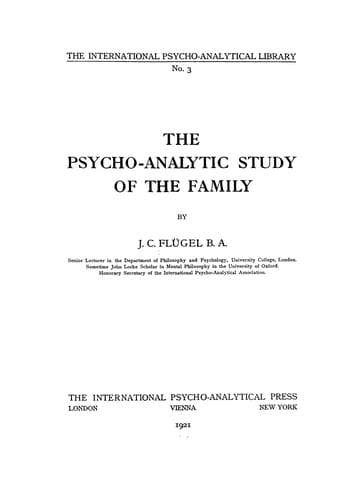
The psycho-analytic study of the familyFlugel, J. C. (John Carl)
Science
The psycho-analytic study of the family
Flugel, J. C. (John Carl)
Families; Marriage; Parent and child; Psychoanalysis
[Sidenote: But the relations between parents and children must undergo
profound modification as time passes]
This is not to say however that the manifestations of this energy will not
undergo considerable alteration as time passes. As children grow up and
parents grow older, the former increase, the latter decrease in natural
strength and ability of mind and body. In course of time therefore the
attitude which parents and children naturally and reasonably adopt towards
each other must gradually change to suit the varying conditions. At first
children are dependent on the guidance and protection of their parents,
who must make the necessary efforts to help and rear their offspring.
Later on this differentiated relationship should give place to one in
which parents and children are on equal terms. Finally, the original
relationships may become to some extent reversed and, if parents and
children are still within reach of one another, the former may come to
look to the latter for some return of that help and protection that they
themselves had previously afforded.
[Sidenote: The care of the aged by their children]
[Sidenote: is culturally very desirable]
In this last situation, we see a form of the relationship, which appears
to be peculiar to human society. Throughout the animal world and even
in many primitive human communities there is no thought or care or
tenderness devoted to old age. The increasing moralisation of human
character (in which the relationship between parent and child has probably
played a leading part) has brought it about that at least some degree
of attention is given in all civilised societies to the needs--material
and mental--of those who are no longer able fully to support themselves
or to carry on their life without assistance. In any society in which
the family is a permanent and firmly organised social unit, the duty
of caring for the aged will naturally fall to some extent upon their
children. This care of elderly, lonely or infirm parents by their children
may perhaps legitimately be considered one of the most beautiful and
touching expressions of specifically human morality--a point in which
Man has definitely risen superior to the conditions of a brutal struggle
for existence. As such it both deserves, and stands in need of, every
encouragement and support which a developed and enlightened system of
practical Ethics can afford.
[Sidenote: though it has of necessity its limitations]
Public-domain text, read in full here on John Shaqi.
Reviews
Reviews
No reviews yet
Be the first to share your thoughts on this work.
Elsewhere in the archive
Join the Discussion
Join the discussion
Sign in to leave a comment or review.
Sign InorCreate an account