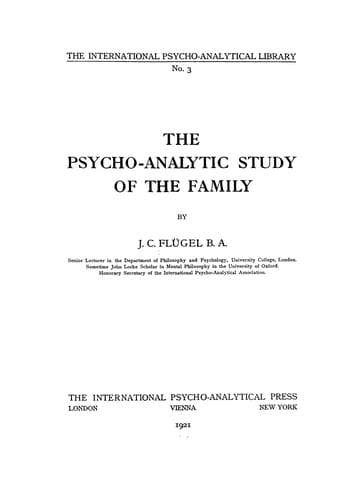
The psycho-analytic study of the familyFlugel, J. C. (John Carl)
Science
The psycho-analytic study of the family
Flugel, J. C. (John Carl)
Families; Marriage; Parent and child; Psychoanalysis
With reference to the moral tendencies which are operative in producing
modifications of the primitive hatreds of the child there can be
little doubt that here also herd instinct is in many cases a factor of
importance. At quite an early age, the child begins to learn that it is
"right" to love and obey its parents and "wrong" to resist the dictates
of the parental authority or to quarrel with its brothers or sisters:
and these precepts are constantly inculcated with all the impressive
suggestiveness which social, educational and religious influences have
at their command. Of equal, if not greater, importance, however, is the
tendency of the child to feel affection towards those with whom it lives
in intimate relationship, to whom it is indebted for all or most of its
material possessions and enjoyments and whom it in many cases admires and
looks up to as the ideal of fully grown humanity to which it may itself
one day attain. The natural growth and development of these feelings
are, however, it is true, helped and encouraged by the moral suggestions
received from outside, whereas these same outside influences tend
powerfully to inhibit the contrary feelings of hatred and hostility.
[Sidenote: The nature and results of Conflict]
After this brief consideration of the nature of the psychic forces which
at a certain stage of development come to be arrayed in opposition to
the primitive manifestations of love and hate as brought out by the
circumstances of family life, we turn now to contemplate the nature and
outcome of the conflict that takes place within the mind between the
two sets of antagonistic tendencies. Our knowledge concerning this and
other similar intra-psychical conflicts has during recent years been very
considerably increased by the work of Freud and other psychologists of
the psycho-analytic school. Generally it may be said that the outcome
of such a conflict varies according to the relative success of one of
the conflicting tendencies over the other. If the two combatants are of
approximately equal strength, there may be a continuous struggle between
them of such a kind as to make itself clearly felt in consciousness;
the individual being then as a rule incapable of vigorous action in
gratification of either tendency. In other cases the competing tendencies
may alternately dominate consciousness and conduct; so that the behaviour
of the individual becomes characterised by impulsiveness and want of
balance rather than by want of energy.
Public-domain text, read in full here on John Shaqi.
Reviews
Reviews
No reviews yet
Be the first to share your thoughts on this work.
Join the Discussion
Join the discussion
Sign in to leave a comment or review.
Sign InorCreate an account