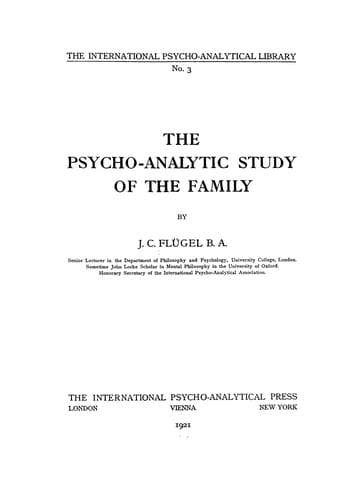
The psycho-analytic study of the family — John Shaqi
The psycho-analytic study of the familyFlugel, J. C. (John Carl)
Science
The psycho-analytic study of the family
Flugel, J. C. (John Carl)
Families; Marriage; Parent and child; Psychoanalysis
In so far as these attempts have been successful (and in the case of
Silberer's work at any rate the evidence brought forward in favour of the
simultaneous existence of the two tendencies as symbolised in the same
legend would appear to be very considerable) they afford some ground for
accepting Jung's interpretation of the incest fancies as constituting,
in one of their aspects, an expression of certain ideas and tendencies
relating to the original conditions of dependence in which a child stands
towards its parents--tendencies which exist alongside, and to some extent
independently, of the sexual tendencies to which expression is more
directly and obviously given.
The symbolic expression in this case, however, would appear to differ
in some important respects from symbolic representation (in dreams and
elsewhere) of the Œdipus complex proper. In the latter the symbolic form
is largely, if not entirely, due to the action of Repression, which does
not permit the morally tabooed incestuous and hostile tendencies to find
expression in any but an indirect manner, whereas in the present case the
aspects symbolised are not in any sense repressed, so that the reason for
the adoption of the symbolic form must be sought in other conditions.
[Sidenote: as a product of repression]
Among these conditions the most important is probably to be found in the
still active repression of the Œdipus complex itself. In so far as the
ideas connected with this complex can be given another meaning, such
as that indicated by Jung, their offensiveness is not felt to be so
great as would be the case if their only significance were that which
most naturally attaches to them: the assumption of the new symbolic
meaning is indeed, in all probability, largely due to the effort of the
repressing tendencies to prevent their true significance from being
realised in consciousness[27]. The new meaning, therefore, as interpreted
by Jung, Silberer and others, obviously corresponds to a more recent and
superficial (though not therefore less real) mental level than does the
original significance in terms of the Œdipus complex.
[Sidenote: and as serving to reinforce the moral tendencies]
Public-domain text, read in full here on John Shaqi.
Reviews
Reviews
No reviews yet
Be the first to share your thoughts on this work.
Join the Discussion
Join the discussion
Sign in to leave a comment or review.
Sign InorCreate an account