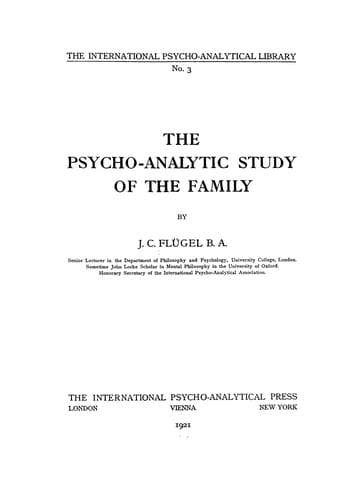
The psycho-analytic study of the familyFlugel, J. C. (John Carl)
Science
The psycho-analytic study of the family
Flugel, J. C. (John Carl)
Families; Marriage; Parent and child; Psychoanalysis
Another reason for the adoption of this secondary symbolism is probably
sometimes to be found in the fact that the ethical or religious
strivings expressed in the anagogic aspects undergo a very considerable
reinforcement through association with the primitive trends which manifest
themselves in the Œdipus complex. The latter lie very much nearer to the
ultimate sources of human feeling and emotion than do the former, which,
by themselves in their abstract purity, are apt to be only too ineffectual
as motives of desire and conduct. But when clothed in the symbolic form
of the Œdipus complex, they at once acquire some of the primitive energy
inherent in the latter and so become themselves more powerful at the same
time as they serve to purify and elevate what remains of the grosser
elements of the original love and hate that the child has felt towards its
parents. Symbolisation of lofty aims and motives in terms of primitive
emotions called up by the family relationships is thus, from this point
of view, an example of the process of sublimation, whereby the energy of
the simpler and cruder human tendencies becomes diverted to the service of
ends of higher cultural and social value[28].
FOOTNOTES:
[Footnote 21: Many of the most important contributions of Jung are
contained in "Collected Papers on Analytical Psychology," 2nd. ed. 1917,
translated by Constance Long, and "The Psychology of the Unconscious,"
translated by Beatrice Hinkle.]
[Footnote 22: For an important discussion of the general laws of
symbolism, see Ernest Jones's "Papers on Psycho-Analysis" 1918, 129. The
whole Chapter is worth careful study in connection with the questions
considered in the present chapter.]
[Footnote 23: "The Interpretation of Dreams," 286.]
[Footnote 24: "Problems of Mysticism and its Symbolism," translated by S.
E. Jelliffe.]
[Footnote 25: As Silberer points out, students of mythology had already
shown the possibility of still a third interpretation, the "naturalistic"
one, according to which the representations of the incest motive in myth
and legend may be taken as a symbolic portrayal of certain important and
impressive natural occurrences--the sequence of day and night, summer and
winter etc.]
[Footnote 26: "Contributions to Psycho-Analysis," translated by Ernest
Jones, 214.]
[Footnote 27: It is interesting to note that in the naturalistic
interpretation of myths the same influences are pretty clearly at work, as
when Max Müller observes that one of the advantages of this naturalistic
interpretation is that it absolves us from the necessity of taking
literally many of the more objectionable features of the myths as they
actually stand.]
Public-domain text, read in full here on John Shaqi.
Reviews
Reviews
No reviews yet
Be the first to share your thoughts on this work.
Join the Discussion
Join the discussion
Sign in to leave a comment or review.
Sign InorCreate an account