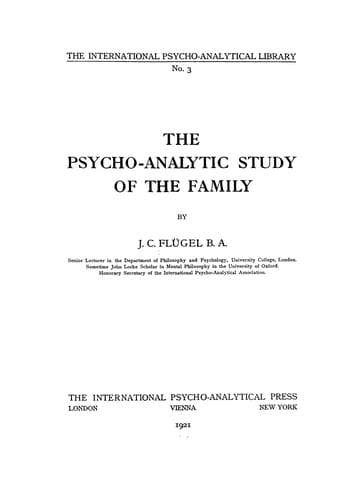
The psycho-analytic study of the familyFlugel, J. C. (John Carl)
Science
The psycho-analytic study of the family
Flugel, J. C. (John Carl)
Families; Marriage; Parent and child; Psychoanalysis
Apart altogether from the questions of mysticism and symbolism, with which
Jung and his followers have tended to surround the whole matter, it is I
think, abundantly clear that normal psychic development involves a gradual
emergence from a condition of dependence on parental authority and care
to one in which the individual is dependent to a greater or less extent
upon his own efforts as regards his livelihood, and upon his own judgment
as regards his conduct[29]. Failure in such development will result in a
relatively feeble adult personality--one which still seeks the support of
its parents (or their substitutes), when it should have learnt to stand
alone. Such failures are, however, (as all psycho-analysts will admit) of
very frequent occurrence. Normal development in this respect appears to
be at least as difficult as in the case of the sexual tendencies we have
already considered, and is liable, as in their case also, to arrests and
retardations at various points and to regressions to earlier stages of
development, whenever serious obstacles and difficulties are encountered.
[Sidenote: Self-preservation]
It would seem possible to distinguish two main aspects of this
process of development, though in real life these two aspects are,
it is almost needless to say, throughout intimately connected with
one another. The first, and more primitive aspect, is that which is
concerned with the actual manifestations of vital activity for the
purpose of self-preservation and for bringing about the fulfilment of
the individual's aims and desires. During babyhood the child is almost
entirely dependent on his parents or other grown-up persons for the
accomplishment of these objects: at best he can only indicate by cries or
gestures the nature of his wants, in order that others may satisfy them.
As he grows older however, he has to learn to fulfil an ever increasing
number of these wants himself--to feed, to wash, to clothe himself and to
satisfy his other bodily needs, to walk abroad without the protection and
guidance of his elders, and generally to attain his desires by his own
efforts rather than to wait for the attentions of others. To keep pace
with the ever growing wants and desires of the individual, a continuous
output of energy is required, and it will sometimes happen that the
motive force immediately available (the strength of the conation) is
not sufficient to overcome the obstacles which prevent the fulfilment
of a want. When this is the case, the individual may react in a variety
of ways. If the conation is a relatively weak one, he may abandon his
attempts to attain the desired end, at least in its original form; or he
may content himself with an imaginary fulfilment of his desire. If the
conation is sufficiently strong, however, it may continue to manifest
itself in different ways; if the first means of approach is unsuccessful,
other means will be tried, until the end is eventually attained. Of these
Public-domain text, read in full here on John Shaqi.
Reviews
Reviews
No reviews yet
Be the first to share your thoughts on this work.
Join the Discussion
Join the discussion
Sign in to leave a comment or review.
Sign InorCreate an account