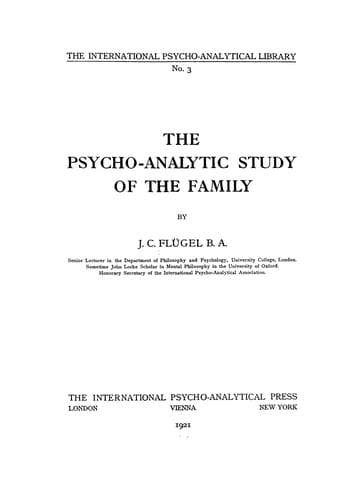
The psycho-analytic study of the familyFlugel, J. C. (John Carl)
Science
The psycho-analytic study of the family
Flugel, J. C. (John Carl)
Families; Marriage; Parent and child; Psychoanalysis
other means, one that is frequently among the most effectual is to call in
the assistance of others. Especially is this the case in infancy when many
feats that are difficult or impossible to the child are easily performed
by its parents or other adult persons, and when such persons (especially
the parents) often take a delight in assisting the child in this way. That
the child should receive such assistance is natural and inevitable at a
certain stage of development, but it is easy to see that help thus given
may constitute a source of danger to the child's development, if it is
granted not only in cases of real difficulty (having regard to the child's
age and capabilities) but in cases where, by the expenditure of a little
additional effort, the child could attain his end unaided. If assistance
is given indiscriminately the child may acquire the habit of relying upon
the help of others whenever any difficulty arises; and this habit may
persist throughout life, rendering the individual a relatively useless
and helpless member of society, incapable of any prolonged or intensive
effort[30]. Normal development, however, implies that the occasions on
which assistance is required should grow fewer and fewer as ability and
experience increase, so that the adult should finally be able to transact
the ordinary business of life and to maintain himself, entirely by his
own efforts, except of course in unusual or exceptionally difficult
circumstances, or where the economic principle of the division of labour
makes it desirable to call in the assistance of other persons possessing
ability or training of a different nature to his own.
[Sidenote: Self-determination]
The other main aspect of the principle of development that we are
considering, is concerned with the matter of self-guidance rather than
with that of self-help. In this respect also, normal development implies a
change from dependence upon others to dependence upon self. In infancy a
very great part of the individual's mode of life is determined by others,
and especially by his parents. Just as he is dependent upon the efforts
of his parents for the necessaries of life, so is he also dependent upon
their decision as to how and when he shall enjoy these necessaries. He
feeds, walks, sleeps, works and plays very largely according to their
pleasure. At most the nature of his play activities is left to his own
discretion. Later on during the school period the authority of the parents
is to some extent exchanged for that of his teachers, but it is not till a
comparatively late stage of development that an individual is allowed to
dispose of the bulk of his time as he himself thinks fit.
Public-domain text, read in full here on John Shaqi.
Reviews
Reviews
No reviews yet
Be the first to share your thoughts on this work.
Join the Discussion
Join the discussion
Sign in to leave a comment or review.
Sign InorCreate an account