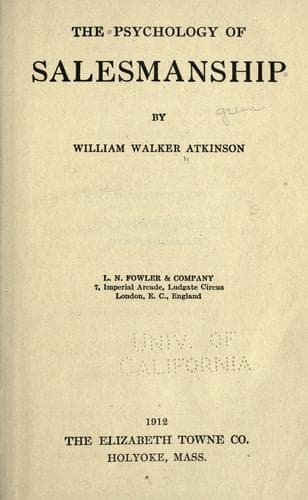
The Psychology of SalesmanshipAtkinson, William Walker
Science
The Psychology of Salesmanship
Atkinson, William Walker
Selling -- Psychological aspects
The perception of the "psychological moment" of closing the selling
talk, is akin to that of the lawyer who leads his jury up to a dramatic
and logical climax--and then stops. Avoid creating an anti-climax. Mr.
Collins in the magazine article mentioned a moment ago says: "The chief
shortcoming of the salesman who has difficulty in closing is, usually,
that he doesn't know when the psychological moment has come to rush his
man. This is a very definite moment in every deal. Veteran salesmen
gauge it in various ways, some by the attention their argument is
receiving, others by some sign in the customer's eyes, and others still
by a sort of sixth sense which seldom leads them wrong. * * * If the
mechanism of a representative sale could be laid bare for study it would
probably approximate the mechanism of the universe in that material
theory by which the philosophers explain the whole thing up to the point
where a slight push was necessary to set it going eternally. The sale of
the man who doesn't close is technically complete except for the push
that lands the order. Sales may be made by patient exposition of facts,
building up the case for the goods. But to close them, very often, a
real push or kick is needed. Logic avails up to the moment when the
customer must be rushed."
The trouble with some prospects is that they have practically made the
Decision--but do not know they have. That is, they have accepted the
premises of the argument; admitted the logic of the succeeding argument
and demonstration; can see no escape from the conclusion--but still they
have not released the spring of formal Decision which settles the matter
with a mental "click." It is the Salesman's business to produce this
mental "click." It is a process akin to "calling the hand" of the
opponent in a certain game other than that of salesmanship. It is the
stage in which the matter is fairly and squarely "put up" to the
prospect. It is a situation demanding nerve on the part of the
Salesman--that is apparent nerve, for it is after all somewhat of a
bluff on his part, for although he wins if the prospect says "Yes," he
does not necessarily lose if the answer be "No!" for the Salesman, like
the lover, should never let one "No" discourage him. "Never take 'No!'
for an answer," says the old song--and it is worth remembering by the
Salesman.
Public-domain text, read in full here on John Shaqi.
Reviews
Reviews
No reviews yet
Be the first to share your thoughts on this work.
Elsewhere in the archive
Join the Discussion
Join the discussion
Sign in to leave a comment or review.
Sign InorCreate an account