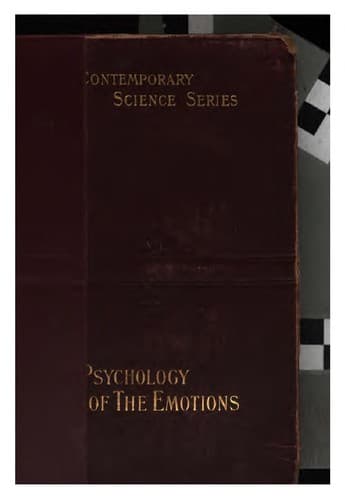
The Psychology of the EmotionsRibot, Th. (Théodule)
Science
The Psychology of the Emotions
Ribot, Th. (Théodule)
Emotions
_Pleasant States._—The same results are obtained, _mutatis
mutandis_, as with the preceding group. I note a very marked
predominance of the motor elements. The pleasures most frequently
mentioned are those of skating, swimming, the trot or gallop of a
horse, and various physical exercises. Those who _really_ revive
agreeable recollections, describe a general state of excitement, a
dilatation of the chest, a lighting up of the countenance, a
tendency towards childish gestures. One, in thinking of his rides,
feels the pleasure of rapid motion, the wind playing over his
cheeks, etc. Musicians can easily revive their pleasure by means of
inner hearing alone. We find one who cannot think of the
_Walkürenritt_ without feeling himself lifted as if by motor
impulses.
4. _Emotions._—The phenomena of this group, though more complex,
are, in fact, only a prolongation of our third group. But, in order
to obtain a correct notion of their revivability, we must not
proceed by way of generalities. To ask any given individual whether
he is capable of reviving past emotions would be a useless question.
I have always asked persons to try and recall a _particular_ case of
a particular emotion (fear, anger, love, etc.). The answers are
reducible to three categories, which I shall enumerate in the order
of their frequency.
In the greater number of cases, only the conditions, circumstances,
and accessories of the emotion can be recalled; there is only an
_intellectual_ memory. The past event comes back to them with a
certain emotional colouring (and sometimes even this is absent), a
vague affective trace of what has once been but cannot be recalled.
In the affective order these subjects are analogous to those of
moderately good visual and auditory memory in the intellectual
order. C——, who, when standing on a rock, narrowly escaped being
surrounded by the tide, sees the waves rising, and recalls his
desperate rush for the shore, which he reached in safety; but the
emotion as such does not return to him. At Constantine, some years
ago, I nearly fell into the gorge of the Rummel. When I think of the
incident I can see before me quite clearly the landscape, the state
of the sky, all the details of the spot; but the only return of
feeling is a slight shiver in the back and legs.
Others (far less numerous) recall the circumstances _plus_ the
revived condition of feeling. It is these who have the true
“affective memory”; they correspond to those who have good visual or
good auditory memories. This is the case with the majority of
emotional temperaments. As we here touch on the most obscure and
disputed part of our subject, it will be convenient to give some
examples.
Public-domain text, read in full here on John Shaqi.
Reviews
Reviews
No reviews yet
Be the first to share your thoughts on this work.
Elsewhere in the archive
Join the Discussion
Join the discussion
Sign in to leave a comment or review.
Sign InorCreate an account