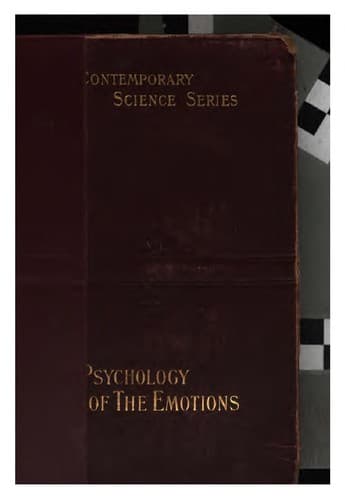
The Psychology of the EmotionsRibot, Th. (Théodule)
Science
The Psychology of the Emotions
Ribot, Th. (Théodule)
Emotions
Irascible subjects, on hearing the name of their enemy, at the mere
thought can revive the rising feelings of anger. The timid person
shudders and turns pale when recalling the danger once incurred. The
lover, thinking of his mistress, completely revives the state of
love. If we compare the recollection of an extinct passion with the
occurrence to the mind of a passion still existing, we shall clearly
perceive the difference between intellectual and affective memory,
between the mere recollection of the circumstances and the
recollection of the emotion as such. It is a serious error to assert
that only the conditions of the emotion can be revived, not the
emotional state itself. I now only touch on this question, to which
I shall return.
Several of my correspondents affirm that the memory of an emotion
affects them as strongly as the emotion itself, which I have no
difficulty in believing. Does not the recollection of a foolish
action make one blush? One asserts that “her representation of
emotions is more acute than the emotions themselves, and that she
can recall them much better than visual, auditive, and other
sensations.” But a few detailed observations will make the nature of
true affective memory clearer.
Littré relates that, at the age of ten, he lost a young sister under
very painful circumstances. He felt acute grief at the time; “but a
boy’s sorrow does not last long.” At an advanced age this grief
suddenly returned, without apparent cause. “Suddenly, without wish
or effort on my part, by some phenomenon of affective automnesia,
this same event reproduced itself with feelings no less painful,
certainly, than those I had experienced at the moment of its
occurrence, and which went so far as to bring tears into my eyes.”
It was several times repeated in the course of the following days;
then it ceased and gave place to the habitual recollection, _i.e._,
to the purely intellectual form of memory.[103]
-----
Footnote 103:
_Revue positive_, 1877, p. 660.
-----
It is natural to suppose that emotional revival must be of frequent
occurrence in poets and artists. M. Sully-Prudhomme, whose
philosophical aptitudes are well known, has favoured me with a
written communication on this subject, from which I extract some
passages, with his permission.
Public-domain text, read in full here on John Shaqi.
Reviews
Reviews
No reviews yet
Be the first to share your thoughts on this work.
Elsewhere in the archive
Join the Discussion
Join the discussion
Sign in to leave a comment or review.
Sign InorCreate an account