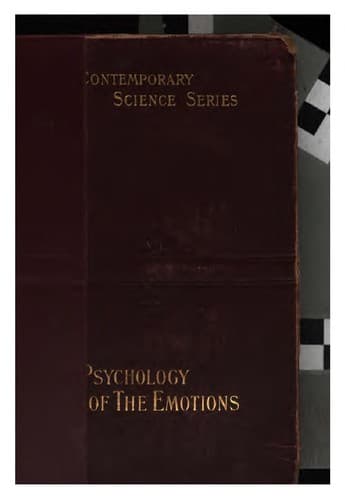
The Psychology of the EmotionsRibot, Th. (Théodule)
Science
The Psychology of the Emotions
Ribot, Th. (Théodule)
Emotions
We cannot at the present point determine rigorously and in detail
what is meant by an emotion (see Part I., Chap. vii.); it is enough
to give a rough but comprehensible definition. From our standpoint,
_emotion is in the order of feeling the equivalent of perception in
the intellectual order_, a complex synthetic state essentially made
up of produced or arrested movements, of organic modifications (in
circulation, respiration, etc.), of an agreeable or painful or mixed
state of consciousness peculiar to each emotion. It is a phenomenon
of sudden appearance and limited duration; it is always related to
the preservation of the individual or the species—directly as
regards primitive emotions, indirectly as regards derived emotions.
Emotion then, even while we keep to its primitive forms, introduces
us into a higher region of the affective life in which its
manifestations become complex. But how can we determine these
primitive forms—the simple irreducible emotions—for this is our
principal aim? Many neglect this determination, or leave it to
arbitrary chance. The old authors seem at this point to have
followed a method of abstraction and generalisation which could only
lead them to entities. It was an accredited doctrine among them that
all the “passions” can finally be reduced to love and hate; we meet
this thesis throughout. To reach this conclusion they seem to have
brought together and compared the different passions, disengaged the
resemblances, eliminated the differences, and by continued
reductions abstracted from this multiplicity its most general
characters.[6]
-----
Footnote 6:
Descartes is a brilliant exception to this method of procedure;
later on we shall have to consider his method (Part II., Chapter
vii.).
-----
If by love and hate we are to understand the movements of attraction
or repulsion which lie at the bottom of the emotions, there is
nothing to be said; but we are only given abstractions and
theoretical concepts; such a determination is illusory and without
practical utility. If we understand love (what love? for nothing is
vaguer than this word) and hate in a more concrete sense, and
pretend to consider them as the primitive source from which to
derive all the other emotions, that is a purely mental opinion, an
assertion which nothing justifies.
The determination of the primitive emotions must be made not by
abstraction and generalisation, but by _verification_. To attain
this I can see but one method to follow—the method of observation,
which teaches us the order and the date of appearance of the various
emotions, and gives us their genealogical and chronological list. We
may count as primitive all those which cannot be reduced to previous
manifestations, all those which appear as a new manifestation, and
those alone; all the others are secondary and derived.
Public-domain text, read in full here on John Shaqi.
Reviews
Reviews
No reviews yet
Be the first to share your thoughts on this work.
Join the Discussion
Join the discussion
Sign in to leave a comment or review.
Sign InorCreate an account