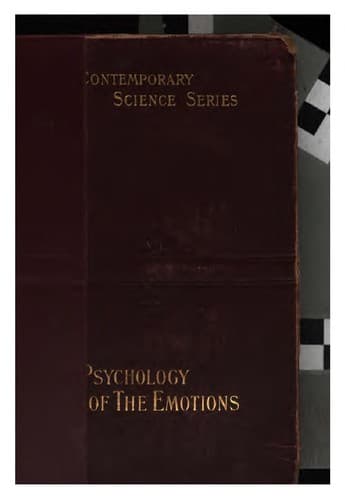
The Psychology of the EmotionsRibot, Th. (Théodule)
Science
The Psychology of the Emotions
Ribot, Th. (Théodule)
Emotions
The materials for this investigation can only be sought in the
psychology of animals and in that of children. The first will give
us but little help. No doubt special and authoritative treatises
enumerate the emotions of animals, but without any distinction
between the simple and the compound, and with no precise indication
as to the order of their appearance. It is not the same with
infantile psychology; the numerous studies published on this subject
during the last thirty years have rendered possible an attempt which
could not be made before.
The question is then to determine in accordance with facts the order
in which the emotions appear, only taking into account those which
seem primitive—that is to say, not reducible to other emotions. I
limit myself to their simple enumeration, with an indication of
their chief characters; each of them will be the object of a special
study in the second part of this book.
1. Fear is the first in date, according to unanimous observations.
Preyer finds that it is manifested from the second day. At the same
time the fact which he records seems to me to agree with surprise
rather than with fear properly so called. In any case, according to
the same author, it is easy to note it after twenty-four hours.
Darwin thought he could only observe it at the end of four months,
Perez at two months. The last is inclined to believe that this
emotion is first aroused by auditory sensations, and then by visual
sensations. The precocity of its appearance has been attributed to
hereditary transmission, an assertion which we shall have to
examine.
2. After the defensive emotion, the offensive emotion appears in the
form of anger. Perez notes it between two and three months; Preyer
and Darwin at ten months; they mean real anger, marked by the
contraction of the eyebrows and other clear symptoms (to throw
itself about, crying, etc.). Naturally the dates indicated for each
emotion are not rigorously fixed; they must vary according to the
child’s temperament and circumstances.
3. Then comes affection. Some authors use the word sympathy, which
seems to me too vague. It shows itself by its fundamental method of
expression, the movement of attraction, the seeking for contact.
Darwin, who has well described it, remarks that it probably appears
very early in life, judging by the infant’s smile, in the second
month, but that he had no clear proof that the child recognised any
one before the fourth month; at the fifth month he showed a wish to
go towards his nurse, but only at twelve months did he show
affection spontaneously and by plain gestures. Darwin adds that
sympathy (?) was manifested exactly at ten months, eleven days, when
the child’s nurse pretended to cry.[7] According to Perez, it
appears towards ten months.[8] It is from this source that complex
forms of great importance must later on be derived—the social and
moral emotions.
-----
Footnote 7:
Darwin, “Biographical Sketch of an Infant,” _Mind_, ii. p. 285.
Public-domain text, read in full here on John Shaqi.
Reviews
Reviews
No reviews yet
Be the first to share your thoughts on this work.
Join the Discussion
Join the discussion
Sign in to leave a comment or review.
Sign InorCreate an account