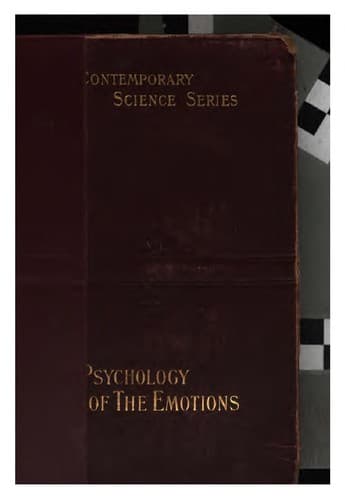
The Psychology of the EmotionsRibot, Th. (Théodule)
Science
The Psychology of the Emotions
Ribot, Th. (Théodule)
Emotions
THE MEMORY OF FEELINGS 140
Can emotional images be revived, spontaneously or
voluntarily?—Summary of scattered facts relating to this
subject—Inquiry into this question, and method
followed—Emotional and gustative images—Internal
sensations (hunger, thirst, fatigue, disgust,
etc.)—Pleasures and pains; observations—Emotions: three
distinct forms of revivability according to
observations—Reduction of the images to three groups:
revivability, direct and easy, indirect and comparatively
easy, difficult and sometimes direct, sometimes
indirect—The revivability of a representation is in
proportion to its complexity and the motor elements
included in it—Reservations to be made on this last
point—Is there such a thing as a real emotional
memory?—Two cases: false or abstract, and true or concrete
memory—Peculiar characters and differences of each
case—Change of the emotional into an intellectual
recollection—Emotional amnesia: its practical
consequences—There exists a general emotional type and
partial emotional types—Confirmatory
observations—Comparative revivability of agreeable and
disagreeable states—To feel acutely and to recall an acute
impression of the feeling are two different operations.
CHAPTER XII.
THE FEELINGS AND THE ASSOCIATION OF IDEAS 172
The function of the feelings, as the cause of
association—The law of affective association, conceived as
general, and as local—I. Function of unconscious feeling:
ancestral or hereditary unconsciousness; personal
unconsciousness arising from cœnæsthesia; personal
unconsciousness arising from the events of our life—Law of
transference by contiguity, by resemblance: wide or
narrow—II. Function of the conscious feelings: accidental
cases, permanent cases, exceptional or rare cases.
_Part II._—SPECIAL PSYCHOLOGY.
INTRODUCTION 187
Importance of the study of special feelings—Utility of
historical documents—Causes of the evolution of the
feelings: (1) intellectual development; (2) hereditary
influence, perhaps reducible to influences of
environment—Cases in which the evolution of ideas precedes
that of feelings—Inverse cases—The intellect swayed by the
principle of contradiction; feeling by that of
finality—Classification of primitive tendencies—Method to
be followed—Group I.: physiological (reception,
transformation, restitution)—Group II.:
psychophysiological—Group III.: psychological—Their
enumeration.
CHAPTER I.
THE INSTINCT OF CONSERVATION IN ITS PHYSIOLOGICAL FORM 199
Public-domain text, read in full here on John Shaqi.
Reviews
Reviews
No reviews yet
Be the first to share your thoughts on this work.
Join the Discussion
Join the discussion
Sign in to leave a comment or review.
Sign InorCreate an account