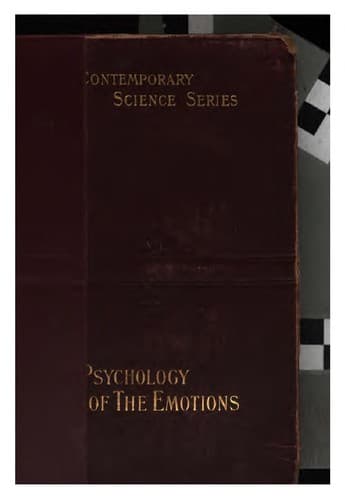
The Psychology of the EmotionsRibot, Th. (Théodule)
Science
The Psychology of the Emotions
Ribot, Th. (Théodule)
Emotions
Hypothesis regarding the relation between the nutritive
organs and the brain—Perversion of the instincts relating
to nutrition—Pathology of hunger and thirst—Proofs
furnished of the priority of these tendencies in relation
to pleasure and pain—Facts in support of this—Negative
tendency; disgust—Its biological value as a protective
instinct.
CHAPTER II.
FEAR 207
Fear the conservative instinct under its defensive
form—Physiology—Psychology—First stage: Instinctive
fear—Hypothesis of heredity—Second stage: Fear founded on
experience—Pathology—Morbid or pathological fears—Two
periods in their study—Attempts at classification—How are
they derived from normal fear? Two groups, connected
respectively with fear and disgust—Inquiry into the
immediate causes: events in life of which a recollection
has been retained; of which no recollection has been
retained—Occasional transformation of a vague state into a
precise form.
CHAPTER III.
ANGER 218
Anger the conservative instinct in its offensive
form—Physiology—Psychology—Anger passes through two
stages, one simple, the other mixed—Its evolution—Animal
form, or that of actual aggression—Emotional form, or that
of simulated aggression—Appearance of a pleasurable
element—Intellectualised form, or that of deferred
aggression—Pathology: Epileptic insanity, corresponding to
the animal form; the maniacal state, corresponding to the
affective form—Disintegrated forms of anger—Overpowering
tendencies to destructiveness—How do they arise and take a
definite direction?—Return to the reflex state—Essential
cause: temperament—Accidental causes.
CHAPTER IV.
SYMPATHY AND THE TENDER EMOTIONS 230
Sympathy is not an instinct, but a highly generalised
psycho-physiological property—Complete sense and
restricted sense—Physiological phase:
imitation—Psychological phase: first stage, psychological
unison; second stage, addition of tender emotion—Tender
emotion—Its physiological expression—Its relations with
touch—The smile—Tears: hypotheses as to their
causes—Tender emotion indecomposable.
CHAPTER V.
THE EGO AND ITS EMOTIONAL MANIFESTATIONS 239
Public-domain text, read in full here on John Shaqi.
Reviews
Reviews
No reviews yet
Be the first to share your thoughts on this work.
Join the Discussion
Join the discussion
Sign in to leave a comment or review.
Sign InorCreate an account