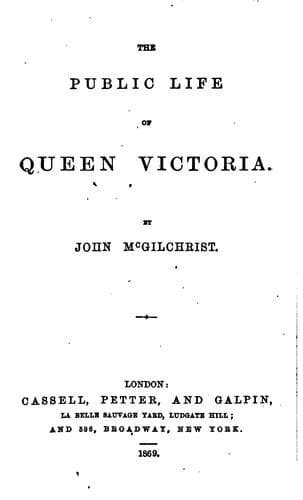
The Public Life of Queen VictoriaMcGilchrist, John
History
The Public Life of Queen Victoria
McGilchrist, John
Victoria, Queen of Great Britain, 1819-1901
In vain we are told that Wren is supposed to have built the south
front, and Kent (a man famous in his time) the east front. We can no
more get up any enthusiasm about it as a building, than if it were a
box or a piece of cheese. But it possesses a Dutch solidity; it can
be imagined full of English comfort; it is quiet; in a good air; and,
though it is a palace, no tragical history is connected with it: all
which considerations give it a sort of homely, fireside character,
which seems to represent the domestic side of royalty itself, and thus
renders an interesting service to what is not always so well
recommended by cost and splendour. Windsor Castle is a place to
receive monarchs in; Buckingham Palace to see fashion in; Kensington
Palace seems a place to drink tea in: and this is by no means a state
of things in which the idea of royalty comes least home to the good
wishes of its subjects. The reigns that flourished here, appositely
enough to this notion of the building, were all tea-drinking
reigns--at least on the part of the ladies; and if the present Queen
does not reign there, she was born and bred there, growing up quietly
under the care of a domestic mother; during which time, the
pedestrian, as he now goes quietly along the gardens, fancies no
harsher sound to have been heard from the Palace windows than the
"tuning of the tea-things," or the sound of a pianoforte.
[Sidenote: KENSINGTON PALACE.]
The associations of Kensington Palace are almost entirely with the earlier
Hanoverian reigns; the later Georges neglected it. Rumour hath it that
this royal domain originated in the establishment of a nursery for the
children of Henry VIII. If it were so, Elizabeth and Victoria must have
been brought up on the same spot; but the tradition is not well supported.
Its first ascertained proprietor was Heneage Finch, Speaker of the House
of Commons at the accession of the First Charles, who built and occupied
only a small nucleus of the present structure, which was enlarged from
time to time by most of its successive occupants, but with no pretension,
and without much plan. From the second Earl of Nottingham, the grandson of
Finch, William III. bought the house and grounds. The latter he enlarged
to the extent of twenty-six acres. To these Anne added thirty, and to
these in turn Queen Caroline, wife of George II., added three hundred.
The house had been the while proportionately growing. Its last expansion
was contributed by the Duke of Sussex.
Public-domain text, read in full here on John Shaqi.
Reviews
Reviews
No reviews yet
Be the first to share your thoughts on this work.
Join the Discussion
Join the discussion
Sign in to leave a comment or review.
Sign InorCreate an account